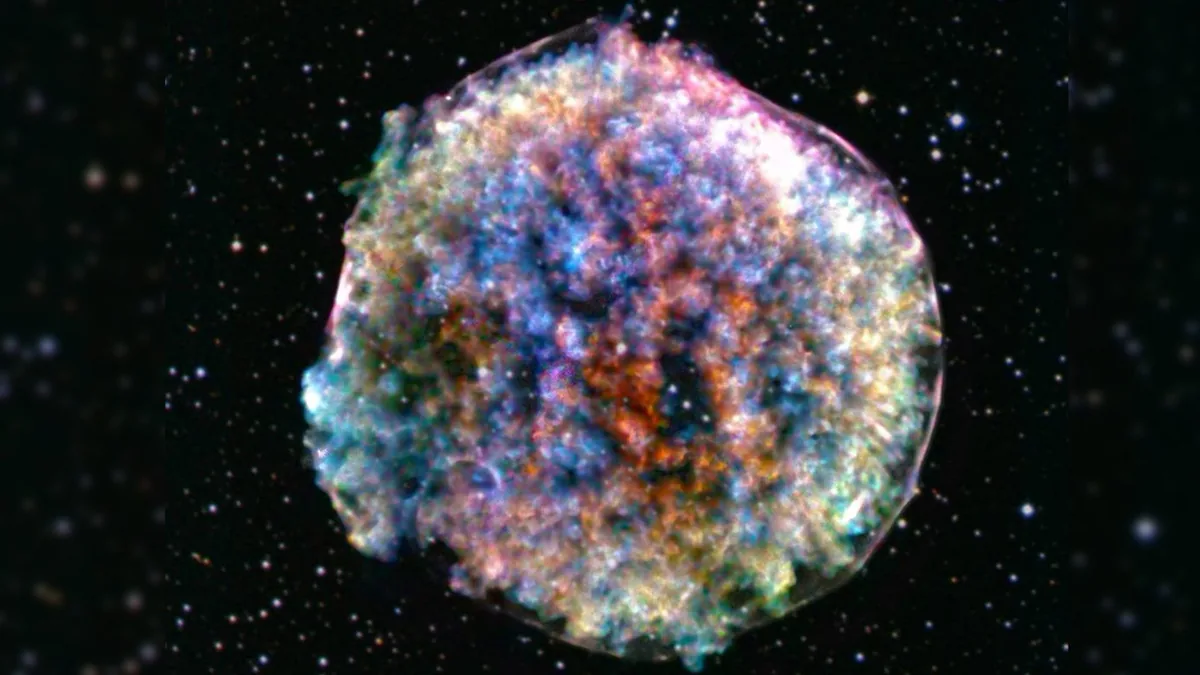
A Sudden Cosmic Blaze in the Cassiopeia Constellation
On the night of November 6, 1572, German astronomer Wolfgang Schuler looked toward the constellation Cassiopeia and sighted an exceptionally brilliant point of light where no star had previously existed. Made decades before the invention of the astronomical telescope, this naked-eye observation documented a cosmic cataclysm that soon rivaled the brightness of Venus, remaining visible even in broad daylight for several weeks and captivating observers across Europe.
Precise Parallax Measurements by Tycho Brahe
Following Schuler's initial detection, Danish astronomer Tycho Brahe undertook an extensive campaign of precise angular measurements using large sextants. Crucially, Brahe established that the 'new star' exhibited no measurable daily parallax, demonstrating conclusively that the phenomenon resided far beyond the Moon in the realm of the fixed stars, rather than being an atmospheric or meteorological disturbance as prevailing scholastic thought suggested.
Overturning Aristotelian Dogma and Birthing Modern Astronomy
For centuries, Western natural philosophy had adhered to the Aristotelian doctrine that the celestial sphere was immutable, pristine, and eternal. The discovery of the 1572 supernova shattered this ancient worldview by proving that the distant heavens were subject to dramatic, catastrophic transformations. Today recognized as a Type Ia thermonuclear supernova remnant, this milestone observation provided crucial empirical momentum to the emerging Copernican revolution.

Comments
Loading comments...