A Bright Dawn Encounter in the Morning Sky
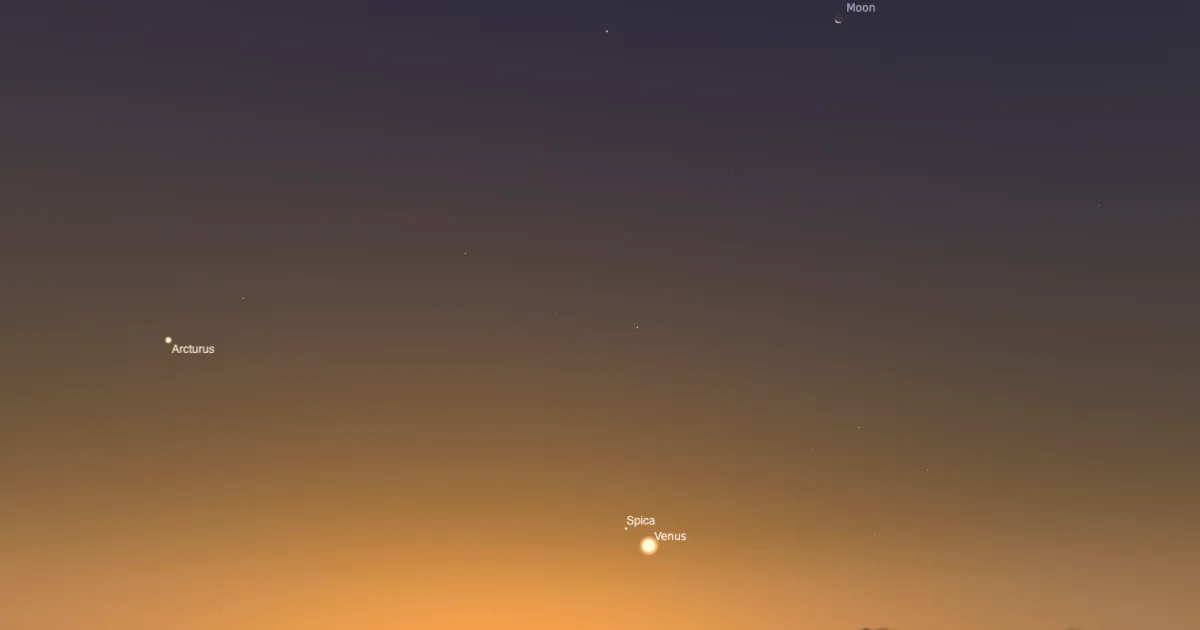
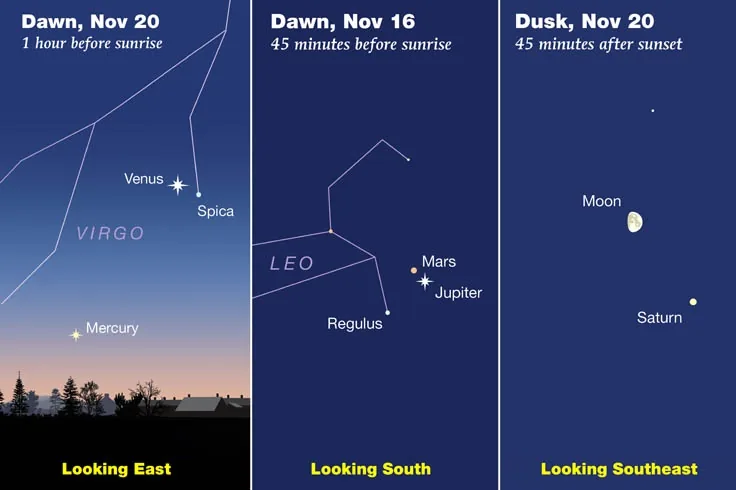
Early risers in the first week of November are treated to a striking celestial arrangement along the eastern horizon. Venus, the brightest planet in our solar system, reaches a close apparent conjunction with Spica, the luminous primary star of the constellation Virgo. Highlighted in weekly astronomical guides, this pairing offers a captivating naked-eye spectacle as dawn begins to break across the hemisphere.
This celestial display follows closely on the heels of the Moon's passage by Regulus in Leo on November 3. As the Moon moves forward along its orbital track, a delicate crescent hangs gracefully above Venus and Spica, completing a memorable visual trio that rewards early morning skywatchers with an exceptional wide-field view.
Observational Coordinates and Sky Geometry
From an observational standpoint, Venus sits just 2 degrees south of Spica in the morning sky. This narrow separation means both objects easily fit into the field of view of standard binoculars or wide-field telescopes, providing a striking visual contrast between the brilliant, sunlit cloud decks of Venus and the distinctly bluish hue of the distant star Spica.
To catch the best view, observers should direct their gaze toward the eastern horizon roughly an hour before sunrise. The slender crescent Moon positioned higher up within Leo serves as an effortless celestial landmark, helping backyard stargazers orient themselves before the brightening morning twilight washes out the fainter stellar background.
Scientific Value and Celestial Dynamics
Apparent conjunctions between planets and bright background stars serve as vivid reminders of the dynamic architecture of our solar system. Because Venus orbits the Sun inside Earth's orbit, its apparent position against the backdrop of distant constellations shifts visibly from week to week, illustrating fundamental celestial mechanics in real time.
Events such as this require no specialized or expensive optical instruments, making them prime opportunities for public stargazing and amateur astronomy. As the Moon continues its monthly journey and Venus continues its orbital path, this temporary celestial arrangement will gradually disperse over the subsequent mornings.
Comments
Loading comments...