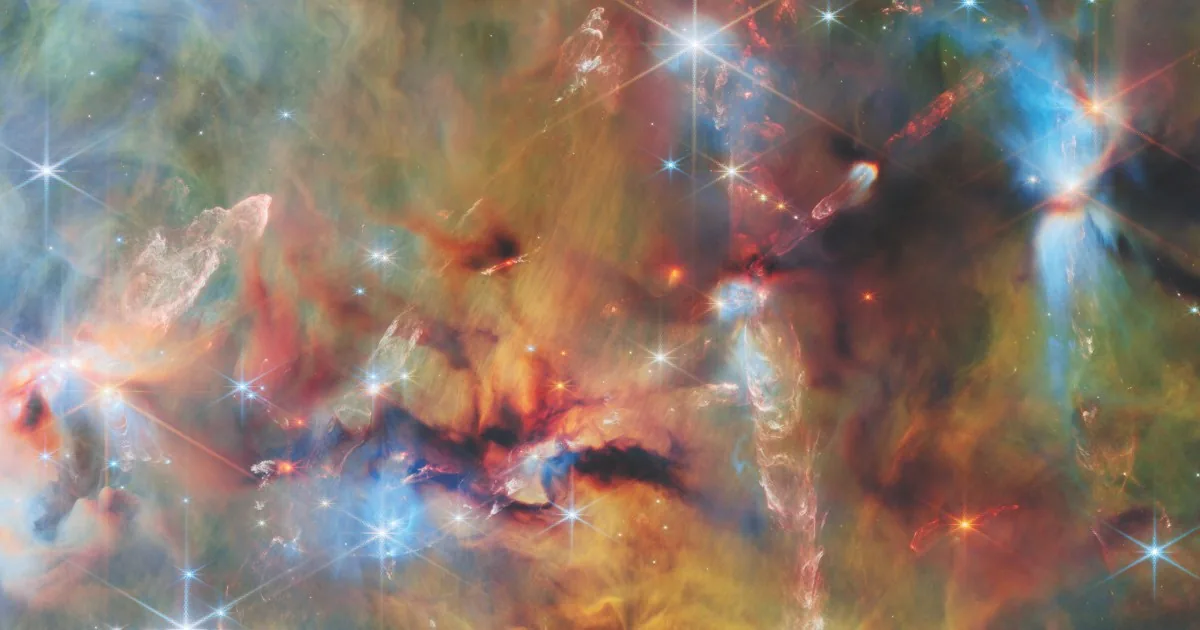
The Iconic Stellar Nursery in Orion
Few celestial sights thrill backyard observers as much as the Orion Nebula (M42). Positioned as the brightest stellar nursery visible from mid-northern latitudes, M42 resolves into a complex web of luminous gas and dusty tendrils even through modest optical telescopes. Its prominence in the night sky has long made it a focal point for understanding how stellar systems take shape from collapsing clouds.
The James Webb Space Telescope (JWST) has turned its powerful vision toward this iconic nursery, piercing the dusty obscuration to reveal the intricate tapestry of the nebula. This survey offers astronomers unprecedented clarity regarding the internal architecture of active star-forming clouds.
The Trapezium Cluster and Nebular Filaments
At the very core of the Orion Nebula lies the brilliant Trapezium Cluster, an ensemble of young and energetic stars that provides the radiation required to set the entire nebula aglow. The intense ultraviolet output from these stars shapes the local interstellar environment, sculpting cavities and driving complex shock fronts through the surrounding gas.
JWST’s detailed observations resolve the fine filamentary networks of gas and dust that thread throughout M42. By dissecting these delicate tendrils, scientists can examine the immediate environments where proto-stellar objects form and interact with the feedback driven by the Trapezium Cluster’s powerhouse stars.
Significance for Understanding Stellar Evolution
Because of its relative proximity, the Orion Nebula serves as an essential laboratory for testing theories of stellar and planetary birth. Studying the interactions between the luminous Trapezium stars and the surrounding dense dust provides critical clues about the conditions under which solar systems emerge.
Data gathered from JWST’s exploration of M42 will refine existing models of stellar feedback, gas dynamics, and disk survival in energetic environments. These observations establish a benchmark for future surveys studying star-forming nurseries across our galaxy.
Comments
Loading comments...