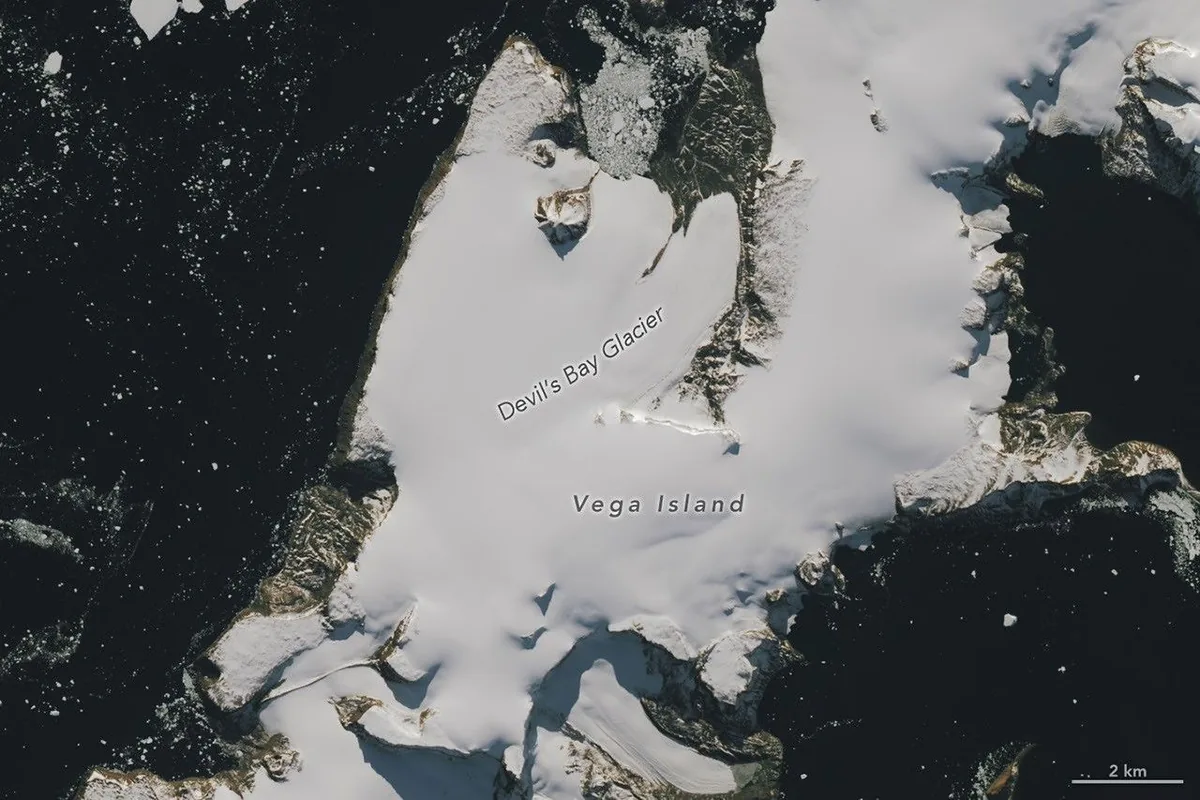
An Eerie Geological Feature Spotted from Space
NASA Earth-observing satellites have documented a remarkably uncanny formation situated along the desolate fringes of Antarctica. Overlooking the Antarctic Peninsula on Vega Island, an icy, skull-like visage emerged within the high-latitude terrain, illustrating the dramatic visual textures shaped by our planet's polar processes. Captured from orbit, the stark and chilling silhouette immediately drew fascination from geologists and remote sensing specialists worldwide.
Glacial Carving and Dynamic Polar Morphology
The striking feature on Vega Island is the direct result of complex interactions between exposed bedrock topography, intense katabatic winds, and continuous freeze-thaw cycles. Snow accumulation and glacial ice draped over rugged depressions and ridgelines cast deep natural shadows, producing optical contrasts that bear an uncanny resemblance to human facial anatomy. High-resolution multispectral sensors aboard NASA spacecraft clearly delineated differences in snowpack density, bare rock exposure, and local ice thickness.
Pareidolia Meets Critical Climate Monitoring
While the formation serves as a classic demonstration of pareidolia—the psychological phenomenon wherein the human mind recognizes familiar shapes within random patterns—it underscores the importance of persistent polar observation. Beyond documenting visual curiosities, NASA's orbital missions continuously monitor glacial mass balance, surface melting rates, and morphological changes across the Antarctic region, providing pivotal empirical data to refine global climate models.



Comments
Loading comments...