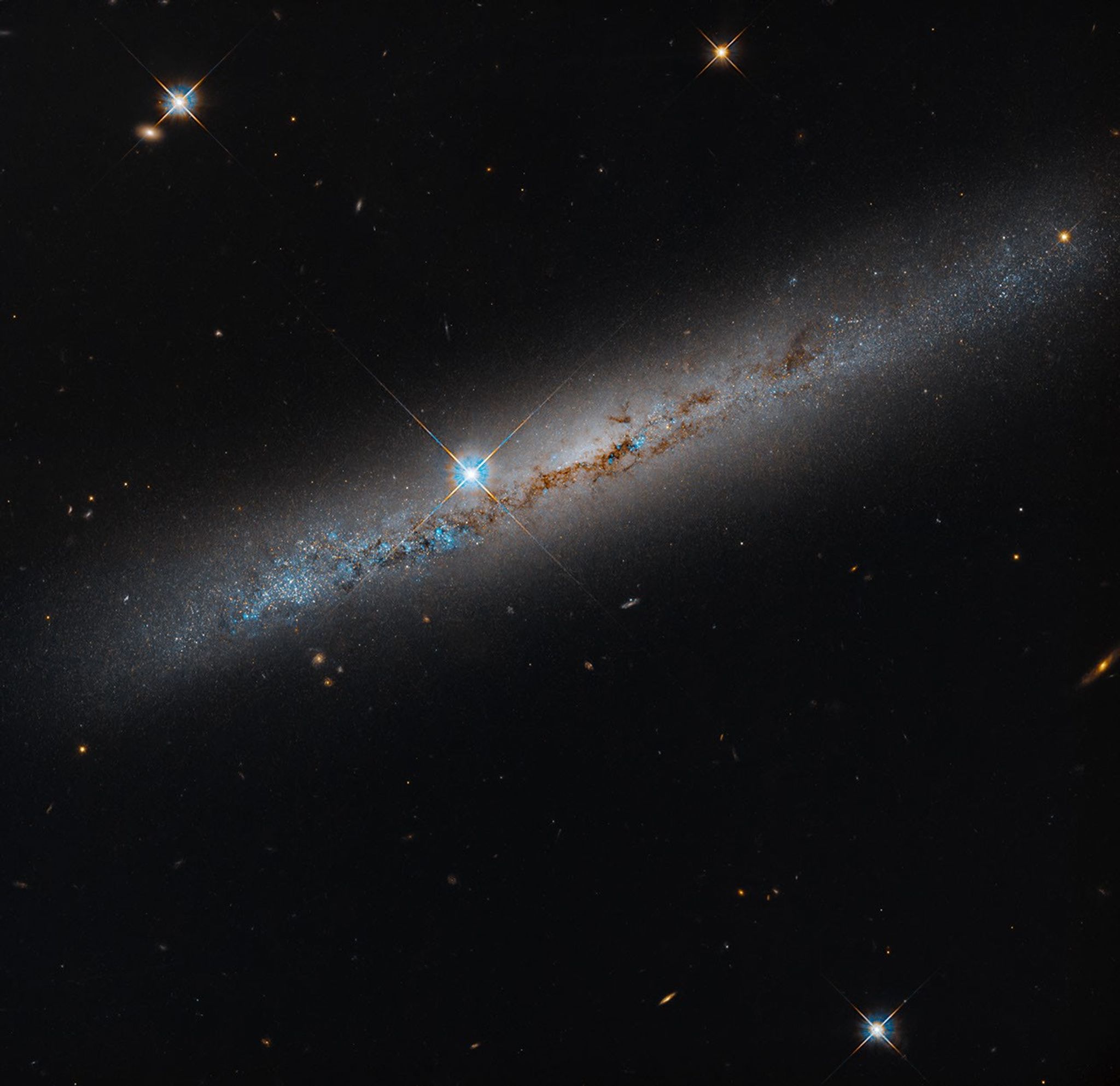
Hubble’s View of Edge-On Galaxy NGC 1827
The NASA/ESA Hubble Space Telescope has added another detailed cosmic portrait to its portfolio by targeting NGC 1827, an intermediate spiral galaxy situated approximately 37 million light-years away in the southern constellation of Columba (the Dove). The observation utilizes Hubble’s high-resolution capabilities to probe the structural characteristics of this stellar system.
Observational Geometry and Dust Lane Architecture
Because NGC 1827 is oriented edge-on relative to Earth's line of sight, its spiral arms are compressed into a sharp lateral profile. This vantage point provides an unobstructed view of the galaxy’s vertical disk scale height, its central galactic bulge, and the complex networks of interstellar dust lanes cutting horizontally through the stellar plane, delineating active star-forming pockets along the disk edge.
Astrophysical Significance for Disk Dynamics
Edge-on spiral galaxies serve as critical astrophysical laboratories for studying the distribution of dust, cold gas, and stellar populations away from the galactic midplane. Data from NGC 1827 allow researchers to refine dynamic models of intermediate spiral disks and quantify light extinction caused by interstellar matter within typical spiral galaxies.


Comments
Loading comments...