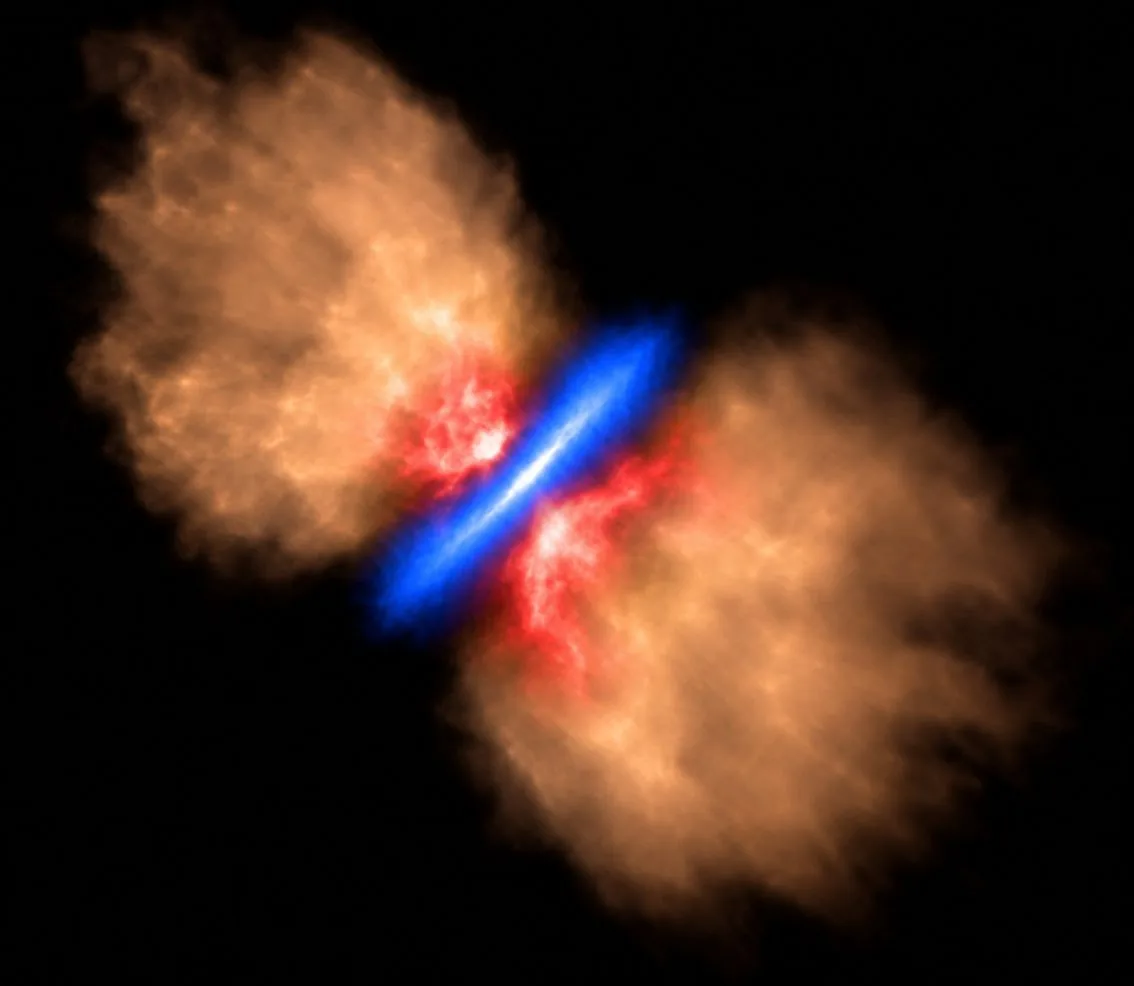
Molecular Discovery Around Orion Source I
An international research team has detected titanium monoxide (TiO) gas around Orion Source I, a young massive protostar located approximately 1,350 light-years away from Earth. The observations were carried out using the Atacama Large Millimeter/submillimeter Array (ALMA), marking a pivotal chemical identification in the immediate environment of this forming massive star.
Signatures of High Temperatures and Disk Winds
High-resolution spectroscopic measurements obtained by ALMA reveal that the gaseous titanium monoxide is concentrated near the base of a disk wind emanating from Orion Source I. Because titanium is a highly refractory element that normally condenses into solid dust grains, its presence in the gas phase indicates intense thermal processing and remarkably high temperatures close to the protostellar disk.
Implications for Massive Star Formation Models
This detection provides valuable constraints on theoretical models governing circumstellar disks and outflow mechanisms around forming massive stars. Tracking vaporized refractory species like TiO opens new avenues for probing physical conditions and chemical pathways in the earliest phases of stellar evolution, underscoring the exceptional observational power of ALMA.

Comments
Loading comments...