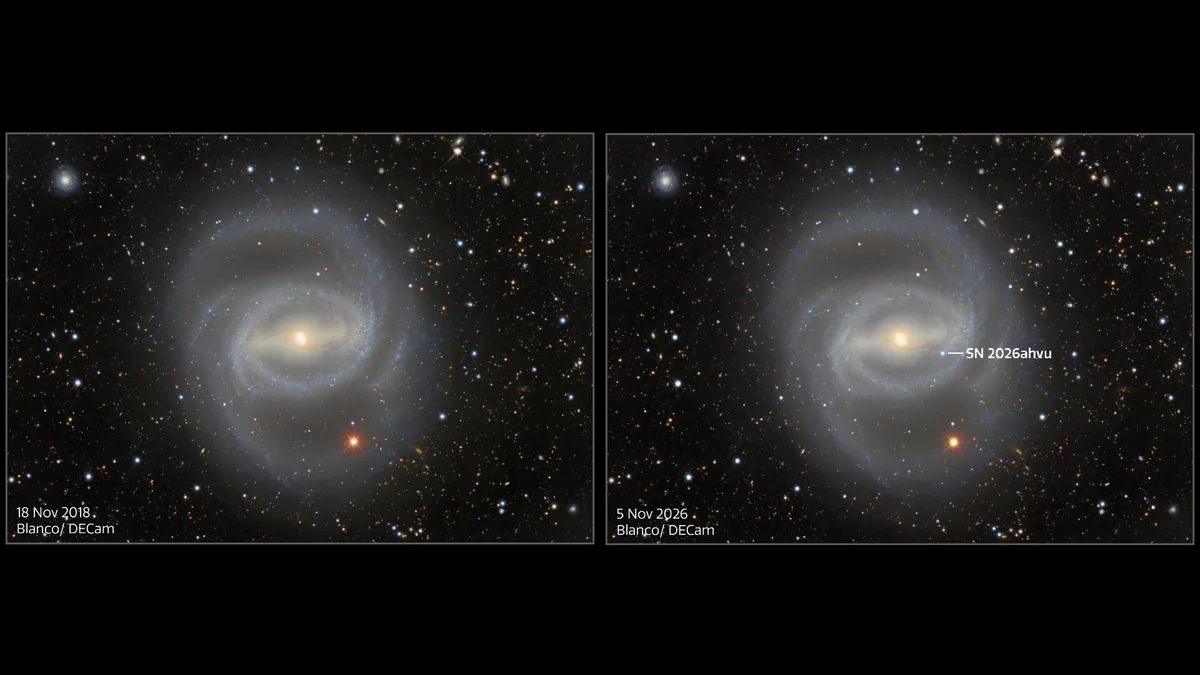
New Supernova Discovered in Spiral Galaxy NGC 1433
Astronomers have detected a massive cosmic explosion taking place in deep space. A new supernova, designated SN 2026 ahvu, has been discovered in the spiral galaxy NGC 1433, located approximately 50 million light-years away from Earth. The detection marks the violent end of a massive star's life cycle.
The host galaxy, NGC 1433, is a spiral galaxy known for its prominent spiral arms and bright core. The occurrence of SN 2026 ahvu within this galaxy provides scientists with a clear opportunity to study stellar death and energetic shockwaves across vast cosmic distances.
Observational Details of SN 2026 ahvu
Initial images and optical measurements captured the dramatic rise in brightness as the supernova unfolded. Despite the vast distance of roughly 50 million light-years, the detected light signal clearly illustrates the extreme violence of the stellar collapse.
Preliminary measurements of SN 2026 ahvu offer key clues about the progenitor star's mass and chemical makeup. Astronomers are actively analyzing light spectra to classify the specific type of supernova and understand the underlying explosion physics.
Understanding Stellar Deaths in Distant Galaxies
Supernovae play a pivotal role in enriching the interstellar medium with heavy elements and triggering future star formation. This latest explosion in NGC 1433 adds valuable empirical data for studying supernova rates and stellar evolution within spiral galaxies.
Scientists plan to continue monitoring SN 2026 ahvu over time to track its light curve decay and the expansion of the supernova remnant. These follow-up observations will help quantify the total energy and material ejected into space.
Comments
Loading comments...