The Overlooked Giant of the Asteroid Belt
The dwarf planet Ceres is arguably one of the most overlooked and underappreciated planetary objects across the solar system. Even though Ceres shares the official dwarf planet designation with Pluto, it is largely treated simply as an asteroid due to its orbital location within the main asteroid belt. However, Ceres is far from an ordinary space rock; it is the single largest object in the main asteroid belt and accounts for roughly 25 to 30 percent of the belt's total mass.
Unlike typical asteroids, Ceres boasts a complex interior that is distinctly differentiated into layers, much like Pluto and major rocky planets. This layered internal structure highlights that Ceres experienced significant geological processes and heat during its early developmental stages.
Cryovolcanism and Distinct Bright Spots
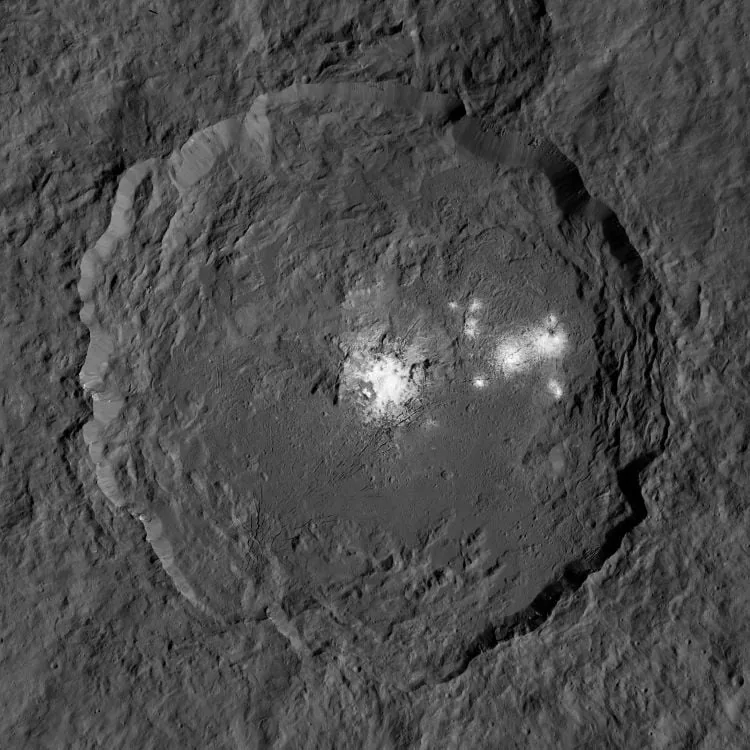
The surface of Ceres displays clear evidence of past water ice activity, a phenomenon scientifically recognized as cryovolcanism. Scattered across its terrain are notable bright spots characterized by exceptionally high reflectivity. Scientists have identified these prominent features as extensive salt deposits left behind by historical icy volcanic activity, which can also be masked by overlying water ice.
These reflective deposits represent sites where mineral-rich subterranean brines once reached the cold surface environment. As the volatile water ice sublimated into space, highly reflective salts were left behind, marking locations of past geologic and hydrothermal interactions between rock and water.
Insights Into Formation and Evolution
Investigating these massive salt deposits allows scientists to unravel the broader narrative of how Ceres formed and evolved over billions of years. Understanding the relationship between surface water ice and the underlying salts provides critical data on the dwarf planet's thermal history and chemical inventory.
Ultimately, studying the mineralogy and cryovolcanic residue on Ceres helps refine existing models of how volatile substances were distributed across the early solar system, offering vital context for planetary evolution in the outer asteroid belt.
Comments
Loading comments...