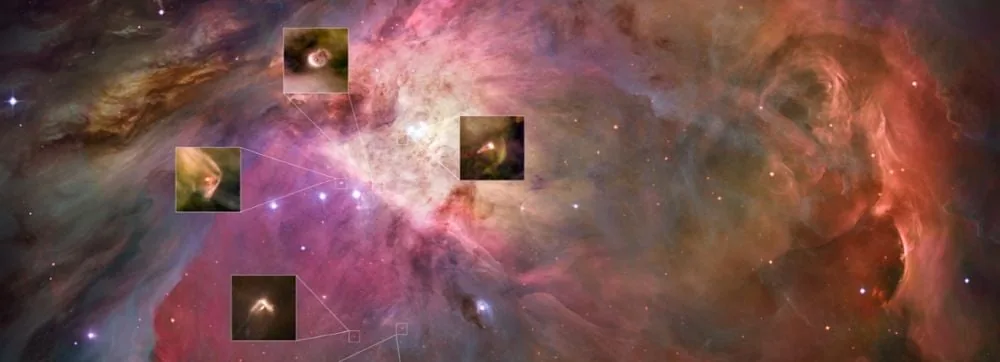
Hubble's Early Observations of the Orion Nebula
Some of the Hubble Space Telescope's earliest and most iconic observations targeted the Orion Nebula, a active star-forming region. These high-resolution images clearly revealed proplyds, which are protoplanetary disks surrounding young stars. However, subsequent detailed observations uncovered a persistent paradox centered on these circumstellar structures that challenged existing stellar evolution theories.
The Mass Loss Paradox of Circumstellar Disks
Given the intense radiation environment of the nebula, these proplyds experience rapid photoevaporation. Measurements indicated that at their observed rate of mass loss, these fragile planet-forming disks should have been completely destroyed long ago. The factual discrepancy between their calculated lifespans and their continued survival presented a major puzzle for astronomers studying early star and planet formation.
Solving the Puzzle Through Stellar Mergers
The resolution to this long-standing paradox lies in stellar merger dynamics. Process models demonstrate that a merger event can alter the dynamics and replenish or preserve the disk mass, explaining why these structures remain visible today. This theoretical breakthrough provides crucial insights into how planetary building blocks survive in extreme radiation environments within dense young star clusters.
Comments
Loading comments...