A New Mathematical Approach for Dating Lunar Craters
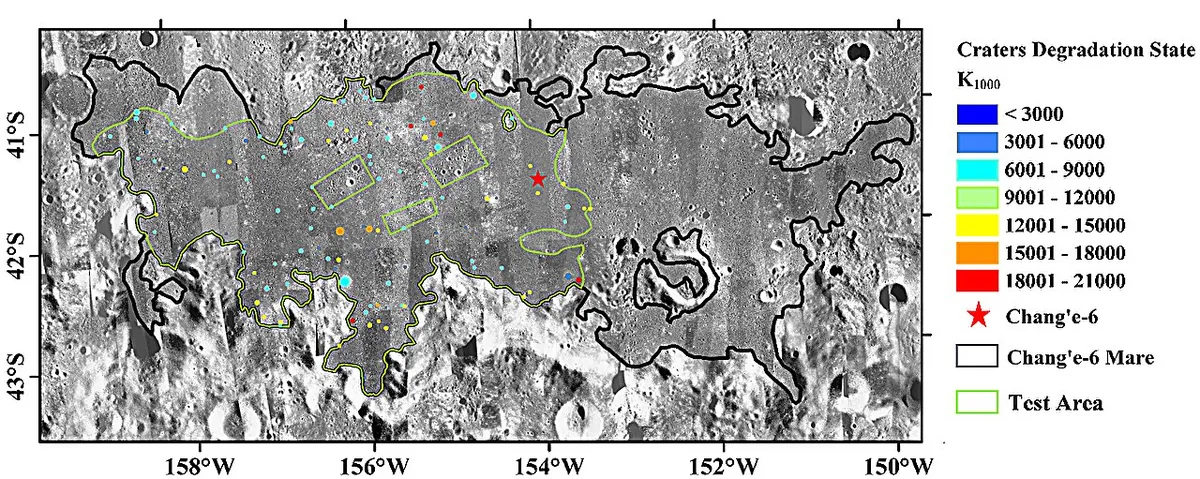
Researchers from the Aerospace Information Research Institute of the Chinese Academy of Sciences (AIRCAS) and their collaborators have developed an innovative method to evaluate impact craters on the Moon. The team established a mathematical model designed to rapidly estimate the degradation state and age of lunar impact craters based on physical structure analysis.
Morphometric Parameters and Chang'e-6 Landing Area Analysis
The mathematical model relies on morphometric parameters to execute its estimations. By converting topographic variations and rim erosion features into numerical metrics, the algorithm enables rapid assessment of complex lunar geological processes.
The scientific team applied their newly developed model to 140 impact craters located within the Chang'e-6 landing site. Extensive tests demonstrated that the model effectively quantifies crater degradation and accurately determines their relative ages across the landing zone.
Significance for Lunar Geology and Surface Evolution Models
Accurate and rapid estimation of crater ages is essential for understanding the geological history of the Moon and the broader impact history of the Solar System. Unlike traditional labor-intensive dating methods, this mathematical framework significantly streamlines large-scale surface mapping.
The insights gathered from the 140 craters in the Chang'e-6 landing area strengthen scientific models regarding lunar surface evolution and degradation dynamics. Researchers anticipate applying this mathematical approach to future lunar missions and other planetary surfaces.
Comments
Loading comments...