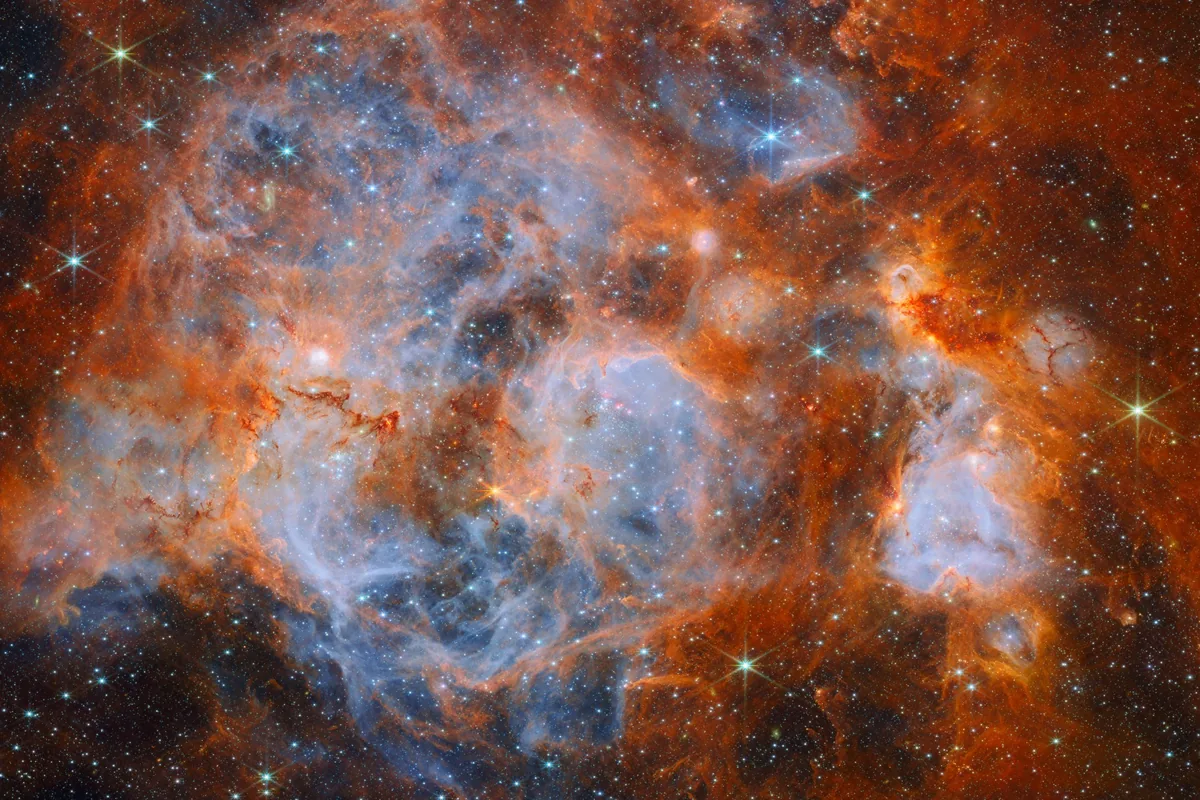
A Deep Look into a Stellar Nursery with the Webb Telescope
In a new image released by NASA on October 22, 2026, astronomers have gained fascinating insights into cosmic star formation processes. The James Webb Space Telescope captured a turbulent star-forming region located within the Large Magellanic Cloud, one of the satellite galaxies orbiting our Milky Way galaxy. Designated as N159, this vast cosmic region lies approximately 161,000 light-years away from Earth and displays a highly dynamic environment.
Turbulent Structures and Physical Characteristics of N159
Observations conducted by the Webb telescope reveal that the N159 region is filled with dense clumps of gas within a chaotic and turbulent cauldron. This active environment functions as a cosmic nursery where new stars are actively being born. Detailed analyses highlight a crucial chemical property of this region: N159 exhibits notably low metallicity, meaning it has a lower abundance of elements heavier than hydrogen and helium compared to typical modern cosmic environments.
Scientific Significance of Low-Metallicity Environments
Studying low-metallicity star-forming regions such as N159 is of paramount importance for astrophysicists. Galaxies in the early universe similarly lacked heavy elements, making N159 an ideal nearby laboratory. By analyzing the dense gas clumps and structural dynamics of N159 with Webb, researchers can refine existing models of star formation and better understand how the first generations of stars evolved in the early cosmos.
Comments
Loading comments...