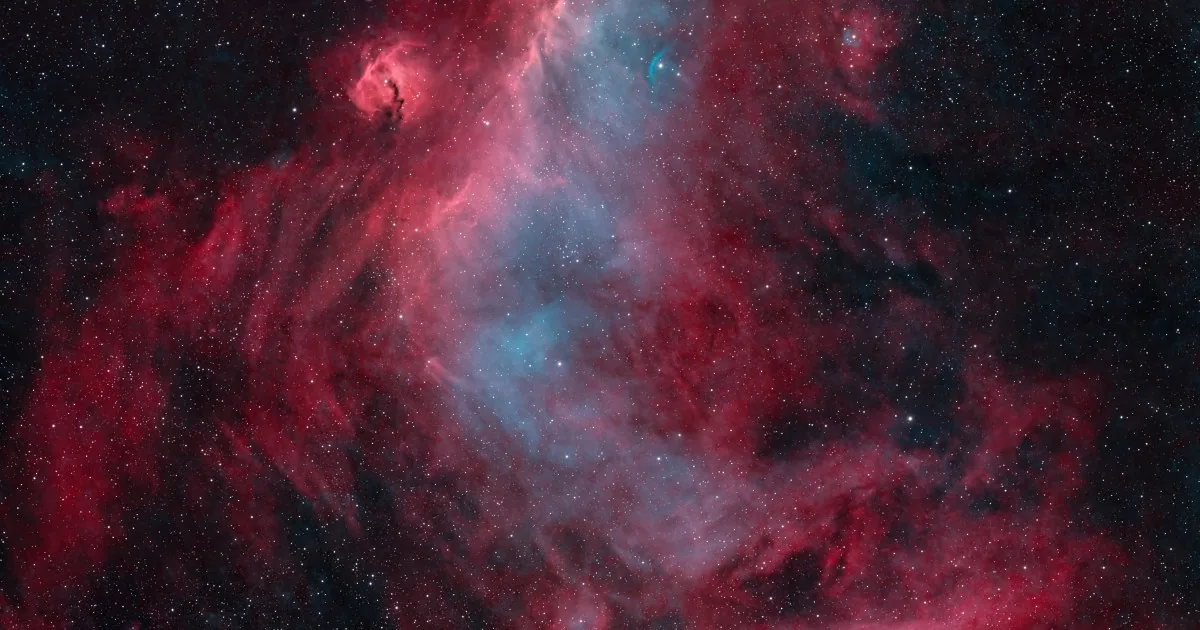
A Nebula Straddling Monoceros and Canis Major
Located approximately 3,600 light-years away, IC 2177, widely known as the Seagull Nebula, is an expansive complex of ionized hydrogen spanning the boundary between Monoceros and Canis Major. Astrophotographer Aquib Ali Ansari from Jaipur, India, captured a wide-field view of this celestial structure using a Samyang 135 mm lens operating at f/2.8.
HOO Palette and Emission Dissections
In this HOO-palette rendering, the nebula's vast, sweeping wings glow in deep reddish hues powered by ionized hydrogen emissions. Meanwhile, the teal-tinted core highlights oxygen gas energized by the intense radiation of young, hot stars embedded inside. This filtration separates the distinct thermal and chemical layers shaping the region.
Windows into Galactic Star-Forming Regions
Emission complexes such as the Seagull Nebula offer critical insights into interstellar matter and stellar nursery mechanics in the Milky Way. Stellar winds from energetic young stars continuously sculpt the surrounding gas clouds, making targeted narrow-band observations vital for tracking ionizing boundaries in our home galaxy.

Comments
Loading comments...