The Milky Way's Neighbor: Small Magellanic Cloud
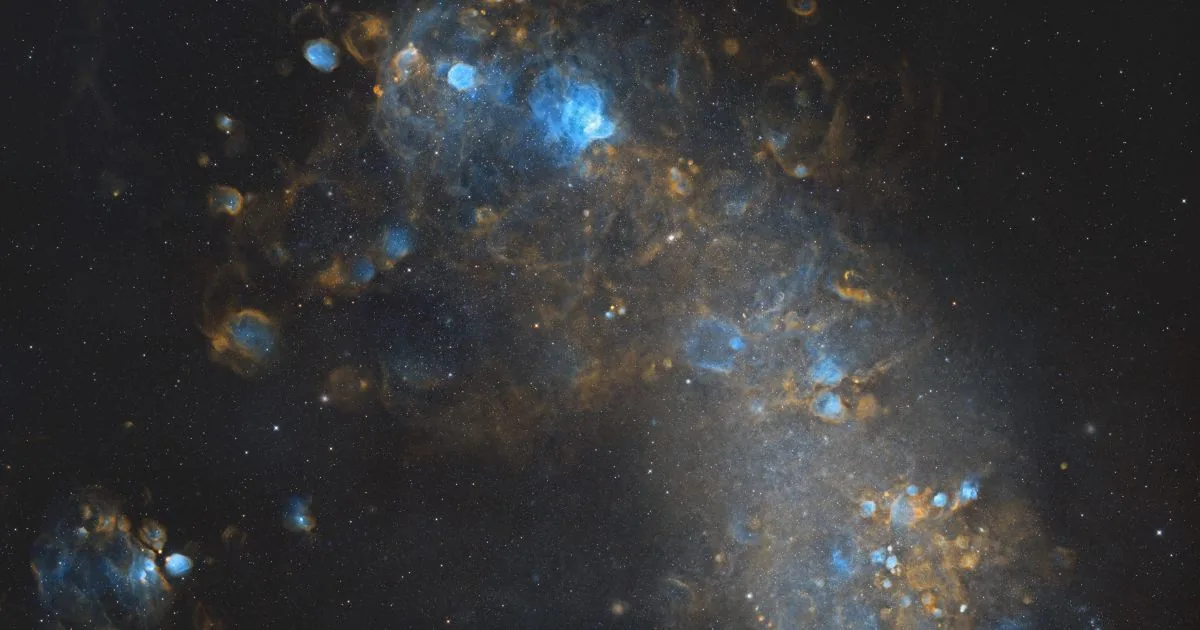
Astrophotographer Clément Daniel from Pleine-Fougères, France, captured a detailed view of the Small Magellanic Cloud (NGC 292), a dwarf satellite galaxy of the Milky Way. Located roughly 200,000 light-years from Earth, this galaxy contains billions of stars and appears to the naked eye as a faint, fuzzy white patch in the night sky.
Narrowband Filtering and Emission Cloud Details
The observation utilized specialized narrowband filters to reveal that the dwarf galaxy is studded with glowing clouds of gas. These optical filters effectively isolated light emitted by ionized hydrogen, oxygen, and sulfur gas distributed throughout the satellite system.
These vibrant gas clouds signify active stellar nurseries where new stars are continuously forming. Spectral filtering techniques allowed for precise mapping of these gaseous structures across the galaxy's extent.
Scientific Significance for Galaxy Evolution Models
Studying star-forming regions and elemental gas compositions in satellite dwarf galaxies is vital for understanding galaxy dynamics and star formation history. The distribution of hydrogen, oxygen, and sulfur provides insight into interstellar medium processes.
Detailed observations of NGC 292 help astronomers refine models of star birth and gas interaction in low-mass galactic neighbors, serving as a baseline for future observatory studies.
Comments
Loading comments...