A Landmark Chapter Closes at the CMS Experiment
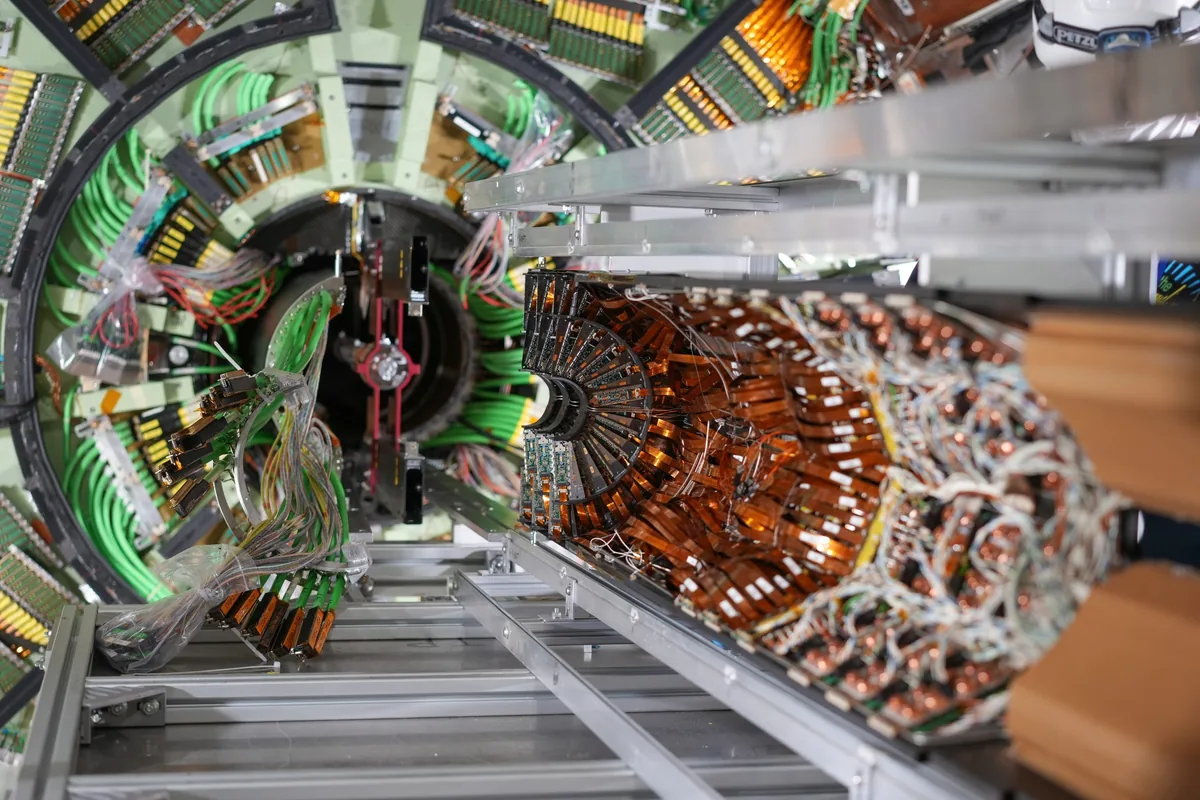
At CERN's Large Hadron Collider (LHC), the core component of the CMS experiment—the pixel detector—has been safely extracted following a decade of successful scientific operations. The delicate extraction procedure, carried out over the span of a single week, marks the conclusion of an immensely fruitful era of particle tracking. This scheduled removal is an essential preparatory step for ongoing upgrades paving the way toward the High-Luminosity LHC (HiLumi) project.
Technical Specifications and Long-Term Performance
Originally proposed in 2010, the Phase-1 pixel detector upgrade was installed in early 2017 during the year-end technical stop. Equipped with approximately 1,800 modules that each housed 66,000 rectangular pixels, the instrument recorded signals generated by charged particles to reconstruct precise trajectories and interaction vertices. Operating across LHC Run 2 (2017–2018) and Run 3 (2022–2026), the detector completed its service while retaining roughly 95% operational efficiency.
Paving the Way for Next-Generation Physics
The decade-long dataset yielded by the pixel detector has provided essential insights into the Higgs sector and searches for physics beyond the Standard Model. With the extraction now complete, teams are preparing to install even more radiation-hard and high-granularity detection systems capable of withstanding the extreme collision rates expected during the HiLumi era. This vital upgrade will allow physicists to probe the fundamental fabric of the universe with unprecedented sensitivity.

Comments
Loading comments...