An Impostor Black Hole in the Large Magellanic Cloud
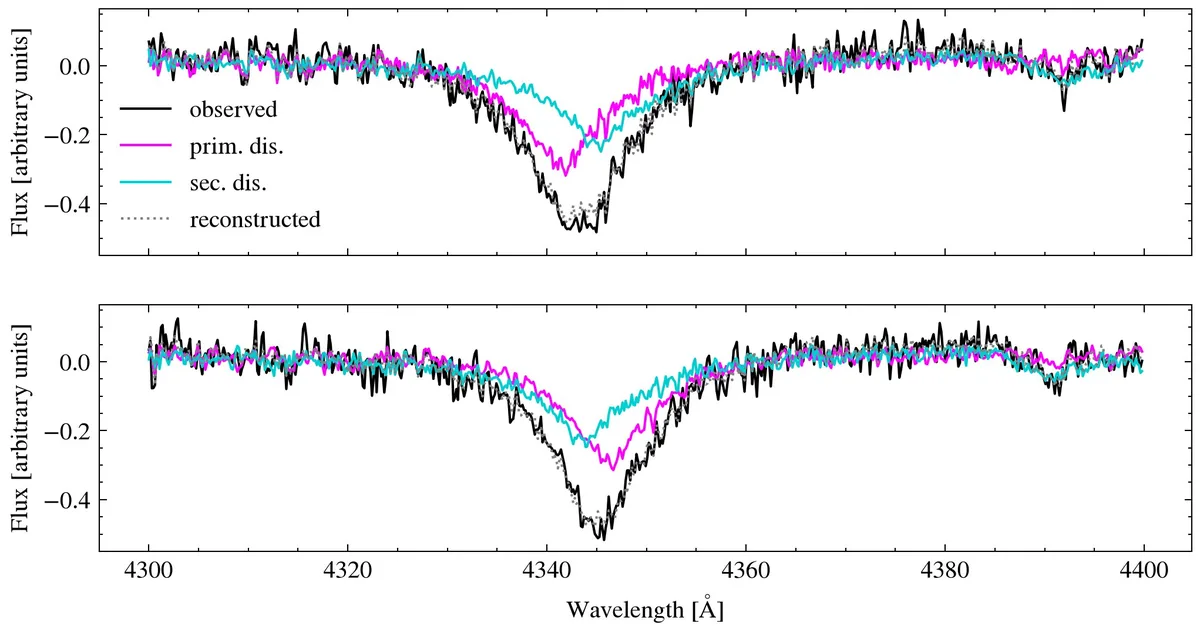
Astronomers studying a strange pair of stars within the NGC 1850 star cluster, located in the Large Magellanic Cloud (LMC), have uncovered a fascinating case of cosmic mistaken identity. The system was initially interpreted as a binary containing a star roughly five times the mass of our Sun orbiting an unseen stellar-mass black hole. However, a new study led by Rhys Seeburger of Liverpool John Moores University demonstrates that this candidate system is actually a black hole impostor, challenging previous astrophysics assumptions.
Observational Details and Deceptive Stellar Dynamics
Massive stars can occasionally mimic the gravitational signatures and complex orbital behaviors of black holes, leading astronomers to misinterpret their fundamental nature. The research paper, posted to the arXiv preprint server on October 27, details how comprehensive observations revealed the true identity of the companion. Rather than a compact dark object, the system features a rapidly spinning star whose extreme rotational velocity generated spectral variations that closely mimicked the gravitational influence of a black hole.
Scientific Significance and Future Observations
This finding highlights the significant challenges observational astronomers face when identifying stellar-mass black holes in binary systems. Correctly classifying such impostors is essential for refining theoretical models of binary star evolution and improving the accuracy of future black hole surveys. The research team emphasizes the need to re-examine other candidate systems using advanced spectroscopic techniques to ensure that stellar mimics are not erroneously counted as black holes.
Comments
Loading comments...