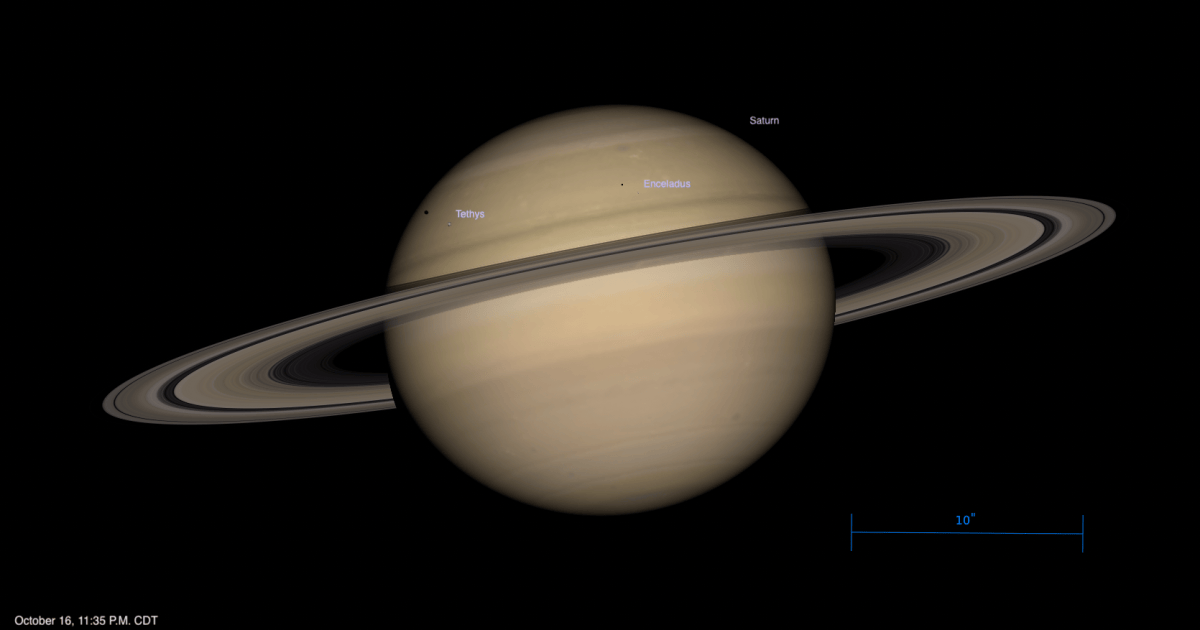
A Rare Transit in the Saturnian System
The Saturnian system continues to offer dynamic celestial events as its extensive satellite retinue interacts with the planet's vast disc and ring system. Among the key skywatching occurrences of mid-October, the icy moon Tethys traverses directly in front of the ringed planet's disk. Accompanying the moon itself is its sharp shadow, cast against the creamy atmospheric bands of the giant planet in a striking transit event.
Observation Timing and Optical Demands
The transit presents optimal viewing geometry for observers across North America, beginning shortly after midnight EDT. While Tethys is a relatively small and predominantly icy world, its high albedo combined with the stark silhouette of its projected shadow makes it a prime target for ground-based telescopes. Astrophotographers and planetary observers equipped with moderate to large apertures are treated to the most favorably timed transit event of the entire month.
Value of Planetary Transit Observations
Events such as Tethys' shadow transit are crucial for illustrating the precise clockwork of orbital mechanics within outer planet systems. Ground-based monitoring of satellite transits allows astronomers to verify ephemeris predictions and assess changing viewing angles as Saturn's ring tilt shifts relative to Earth's line of sight. Observers taking advantage of steady atmospheric seeing will be able to resolve both the faint silhouette of the moon and the distinct dot of its shadow as they track across the disk.


Comments
Loading comments...