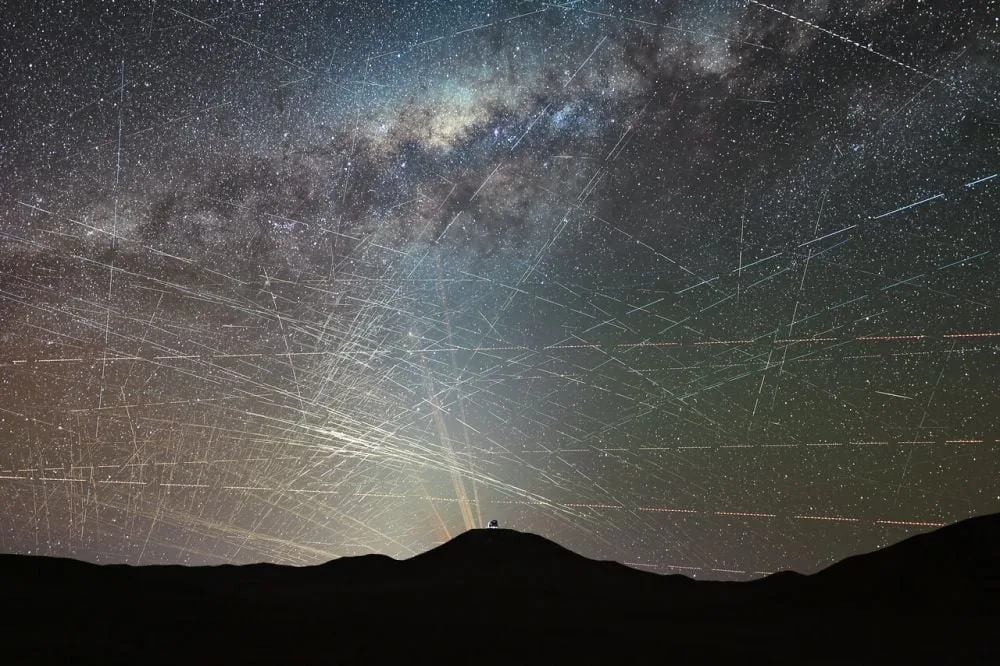
ESO's Alarm Over the Starmind Project
The European Southern Observatory (ESO) has formally expressed profound dismay regarding the regulatory approval of SpaceX's satellite artificial intelligence system, known as Starmind. As one of the world's preeminent astronomical organizations, ESO warns that expanding orbital megaconstellations to unprecedented thresholds will severely cripple observational capabilities at premier ground-based observatories across the globe.
The Threat of One Million Satellites in Low Earth Orbit
The Starmind architecture calls for launching an additional one million satellites into Low Earth Orbit (LEO). Adding a fleet of this scale would catastrophically congest the near-Earth space environment. For ground-based optical, infrared, and submillimeter observatories, these satellites represent an overwhelming source of light pollution and streak contamination. Furthermore, the radio emissions generated by inter-satellite communications and processing networks threaten to blind sensitive radio astronomy receivers studying the distant cosmos.
Implications for the Night Sky and Humanity
The implications of this proliferation extend beyond the operational scope of astronomy. Experts emphasize that deploying unconstrained orbital artificial intelligence systems without rigorous multilateral safeguards presents significant long-term risks. ESO contends that the rapid commercialization and occupation of orbital space must be balanced against scientific preservation, calling for strict regulatory frameworks before the pristine night sky is permanently lost to observation.

Comments
Loading comments...