Stellar Mass and the Shaping of Planetary Architecture
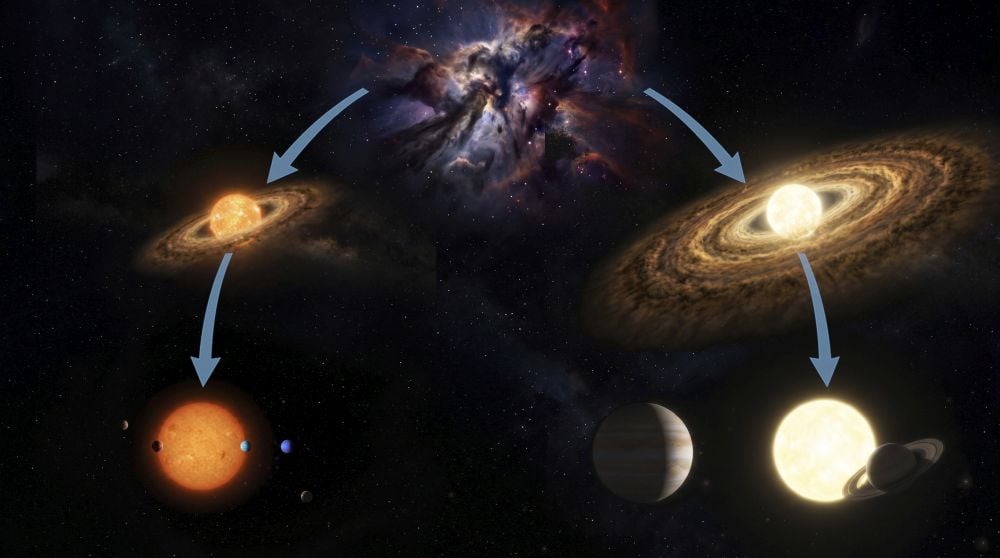
Astronomers investigating the formation mechanisms of exoplanetary systems have identified a direct correlation between the characteristics of a host star and the structural arrangement of its orbiting worlds. The new research establishes that central stars do not merely provide a gravitational anchor, but actively dictate the evolutionary trajectory and spatial organization of their planets. This discovery reveals that planetary architectures across the Milky Way follow organized evolutionary pathways rather than random distributions.
Two Distinct Families Governed by Stellar Mass
The study reveals that planetary systems diverge cleanly into two distinct structural families dictated fundamentally by stellar mass. Higher mass stars systematically generate one family of planetary configurations, whereas lower mass stars foster an entirely different class of system architectures. This fundamental bimodal division provides a new empirical template that reflects how initial protoplanetary disk conditions, stellar radiation fields, and mass reservoirs govern planet growth and orbital migration.
Refining Theoretical Models of Exoplanet Evolution
These findings provide planetary scientists with a refined framework for interpreting exoplanetary surveys and testing theoretical formation models. By categorizing planetary systems through this dual-family template, astronomers can better predict the compositional and dynamical traits of unseen planets around diverse stellar types. Ultimately, understanding how host stars split systems into distinct structural regimes clarifies the formation history of varied planetary worlds, including our own Solar System.


Comments
Loading comments...