The Intriguing Atmospheric Enigma on Mars
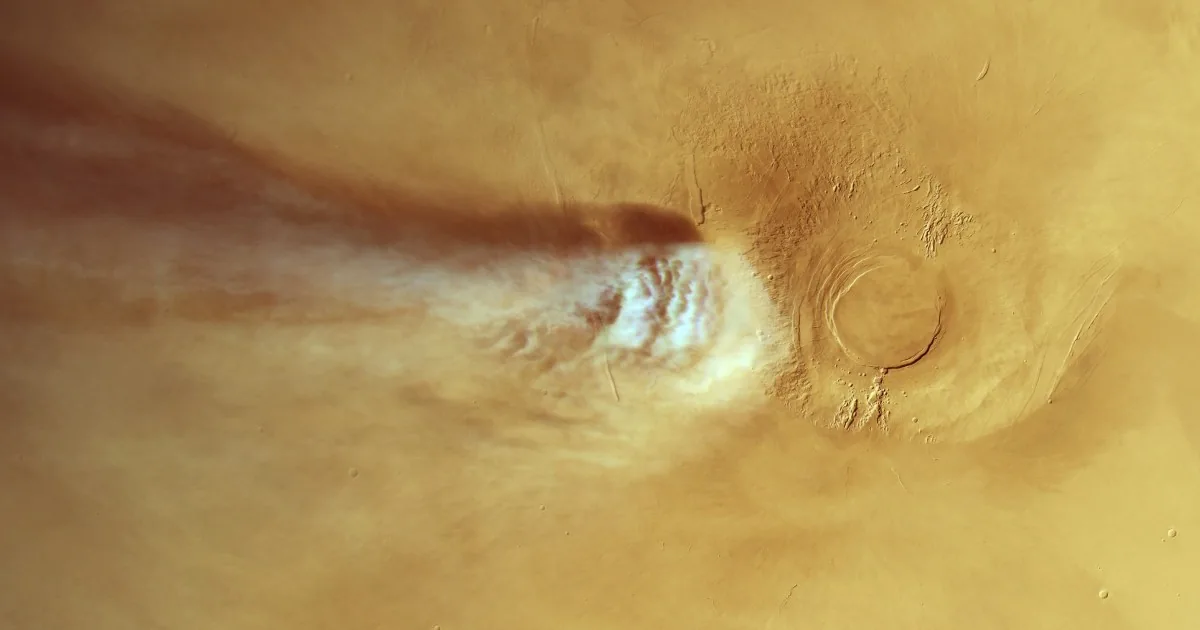
The Red Planet's dynamic atmosphere continues to exhibit meteorological events that challenge planetary scientists. Researchers believe they may finally have a comprehensive explanation for a bizarre cloud structure that appears and promptly disappears each day above an imposing martian volcano during the dusty season. The recurring phenomenon occurs directly above one of the planet's most prominent geological landmarks.
Just after sunrise during spring and summer on Mars, an elongated cloud begins to take shape near Arsia Mons, a massive volcano standing roughly 20 kilometers (12 miles) high. This sharp, recurring timing has made the cloud a focal point for understanding how martian topography interacts with atmospheric vapor under specific seasonal conditions.
An Atmosphere Stretching 1,800 Kilometers
Observational tracking indicates that this peculiar feature reaches staggering dimensions. Originating in the vicinity of the volcano's crest, the elongated cloud stretches out across roughly 1,800 kilometers (approximately 1,100 miles). Despite its vast size, the atmospheric feature is ephemeral, forming quickly in the early morning sunlight and rapidly vanishing as local temperatures climb.
Scientists classify this formation as an orographic feature driven by rising air masses deflected upward by the massive slopes of Arsia Mons. As the morning air is forced to cool rapidly upon ascent, localized water vapor condenses in the dusty seasonal atmosphere, creating a colossal but temporary tail that drifts outward before evaporating into the dry surroundings.
Implications for Martian Climate Science
Uncovering the physical processes behind the daily birth and dissipation of the Arsia Mons cloud refines modern models of the martian atmosphere. Understanding localized water-ice transport and condensation sheds light on how atmospheric moisture moves between the polar caps and equatorial regions during the dust-heavy seasons.
These ongoing atmospheric studies enhance global circulation models, which are essential for mapping weather patterns on Mars. By solving the mystery behind the planet's strangest cloud, scientists can better anticipate local weather risks and atmospheric variations for upcoming robotic and human exploration missions.
Comments
Loading comments...