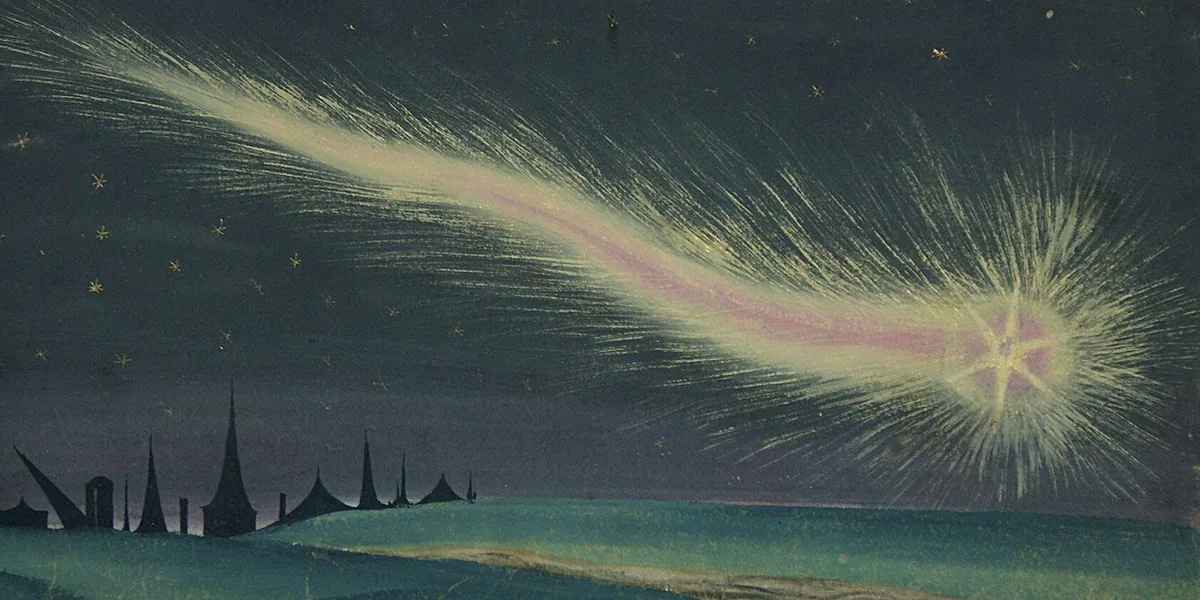
A Celestial Omen on Historic Linen
A renowned sequence on the 11th-century Bayeux Tapestry captures King Harold alongside an anxious crowd gazing upward toward the sky. Embroidered beneath the Latin caption 'Isti mirant stella' ('those people marvel at the star'), the artifact preserves a vivid historical reaction to an unexpected astronomical event.
Halley's Comet and Norman Narrative
Above King Harold looms the radiant form of Halley's Comet, accompanied by faint invasion ships rendered in the lower border. This imagery served a deliberate Norman narrative, framing Harold as a doomed ruler whose broken oaths invited celestial condemnation and destined his kingdom for imminent foreign conquest.
Medieval Perceptions of Cometary Phenomena
Before their orbital mechanics were understood, comets were widely interpreted across Europe as harbingers of political turmoil and divine retribution. The 1066 apparition became deeply woven into the geopolitical narrative of the Norman Conquest, cementing Halley's reputation as a fearsome omen that shaped historical interpretation.



Comments
Loading comments...