A Rare Atmospheric Phenomenon Over Gale Crater
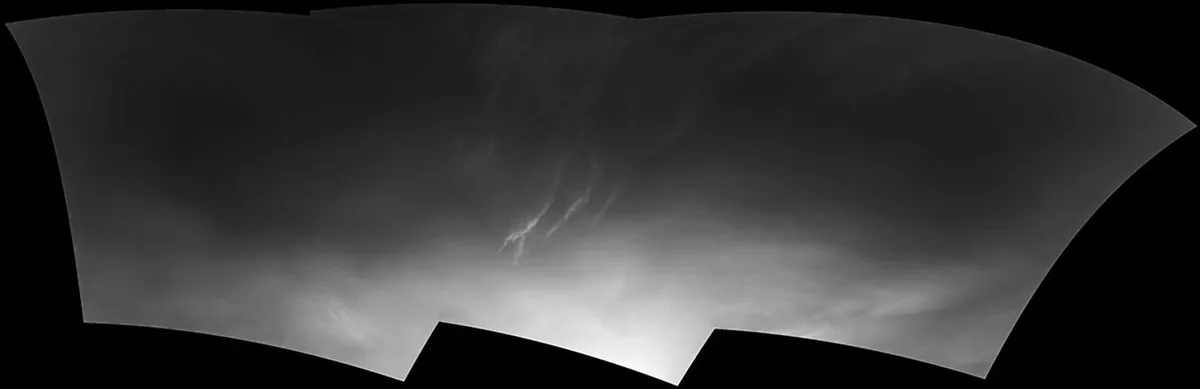
NASA's Curiosity rover continues to monitor dynamic atmospheric events on the Red Planet, capturing drifting twilight clouds on sol 5,061 of its mission. The robotic explorer, which has spent years investigating Gale Crater and its complex surroundings, observed these delicate formations as they passed high above the ancient impact basin.
These seasonal clouds are known to appear over Gale Crater for only a brief period each Martian autumn. Thanks to Curiosity's prolonged operational lifespan on the surface, science teams have been able to document these fleeting meteorological features across multiple seasons.
Capturing Post-Sunset Clouds with Navigation Cameras
The observation was carried out using Curiosity's onboard navigation cameras, which are regularly utilized to scan the Martian sky. Referred to as twilight clouds, these high-altitude formations become uniquely visible shortly after sunset when surface illumination fades.
Because they linger high in the atmosphere, the particles within the clouds continue to catch and scatter residual sunlight even after the Sun has dropped below the local horizon. Curiosity's imaging sequence captured the faint textures and slow drift of the clouds against the dimming Martian sky.
Implications for Martian Climate Science
Tracking the timing and morphology of twilight clouds provides planetary scientists with critical constraints on atmospheric behavior, temperature boundaries, and vapor condensation at high altitudes. In Mars's thin atmosphere, such events serve as natural tracers for wind directions and seasonal circulation patterns.
By comparing these observations with data gathered during previous Martian years, researchers are refining broader atmospheric models for the planet. Curiosity's dual focus on surface geology and atmospheric monitoring continues to enrich humanity's understanding of environmental conditions on modern Mars.
Comments
Loading comments...