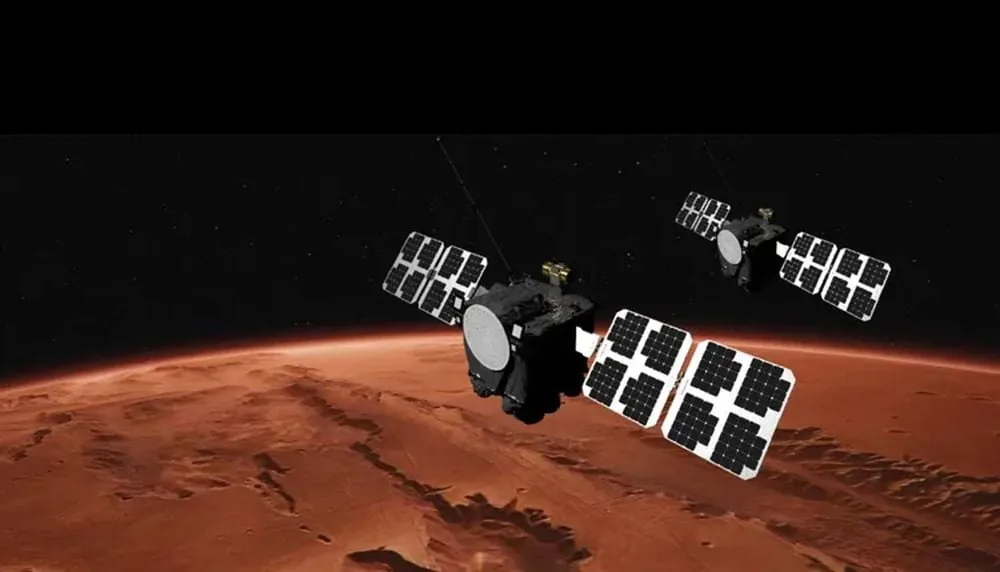
The ESCAPADE Mission and its Unconventional Trajectory
NASA's ESCAPADE (Escape and Plasma Acceleration and Dynamics Explorers) mission consists of a pair of identical spacecraft designed to investigate Mars' unique space environment. However, because the spacecraft launched outside of the standard optimal Earth-Mars launch window, they could not take a direct transfer route to their destination.
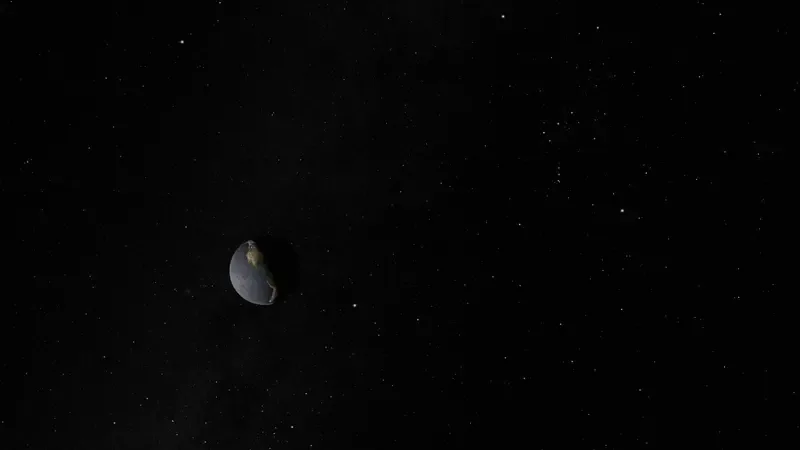
To overcome this orbital challenge and gain the necessary speed, the twin spacecraft will execute powered slingshot maneuvers. By firing their propulsion systems during close planetary flybys, they will maximize gravitational acceleration to reach the Red Planet.
Formation Flying and Measurements Around Mars
Upon arriving in Martian orbit, the ESCAPADE spacecraft will operate in tandem, executing a controlled formation flight. Taking simultaneous measurements from two distinct vantage points will allow scientists to map the dynamic space weather around Mars in real time.
The primary scientific objective is to study how the solar wind interacts with what remains of Mars' ancient magnetosphere, specifically its localized crustal magnetic fields. Onboard plasma sensors and magnetometers will measure particle escape rates and magnetic field fluctuations with high temporal resolution.
Understanding Martian Atmospheric Loss and Future Exploration
Billions of years ago, Mars lost its global magnetic field, leaving its atmosphere vulnerable to erosion by the solar wind. Data gathered by ESCAPADE will shed light on how this atmospheric stripping continues today and help scientists understand how Mars lost its ancient water reservoirs.
Furthermore, the mission demonstrates how low-cost, dual-spacecraft architectures can effectively perform complex interplanetary science, setting a valuable precedent for future deep-space exploration strategies.
Comments
Loading comments...