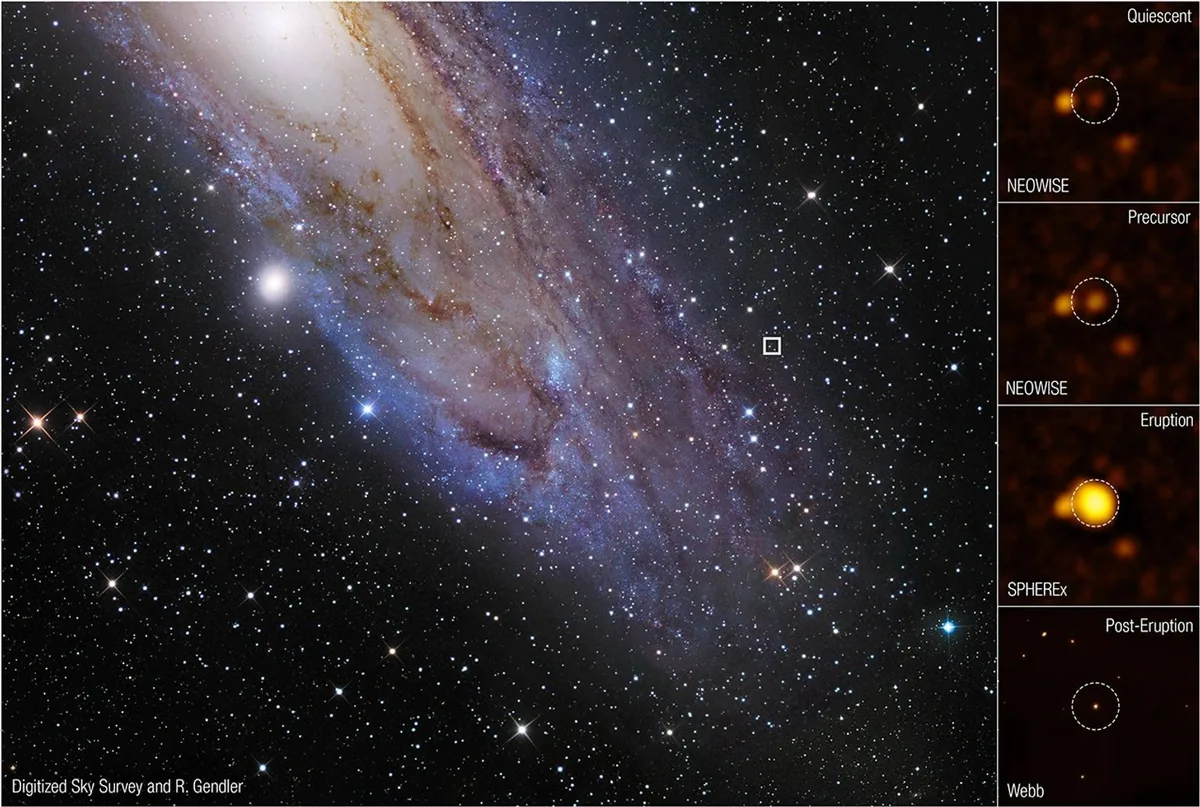
Rare Stellar Merger Discovered in Andromeda Galaxy
Astronomers have identified an extraordinary cosmic event in the outskirts of our neighboring Andromeda galaxy, marking the first discovery of its kind. A star slightly less massive than our Sun was observed spiraling into and merging with a puffy supergiant star. This rare phenomenon gives astrophysicists a direct look into the complex dynamics of stellar mergers.
The discovery, funded by NASA, offers fresh insight into stellar cannibalism and binary system evolution. Occurring at the outer edges of Andromeda, this merger serves as a crucial testbed for existing theoretical models regarding the final evolutionary stages of close binary stars.
The "Rejuvenated" Star Bao and Webb Observations
Following the merger, the newly single object was nicknamed "Bao" by the research team. Potentially "rejuvenated" through this intense cosmic union, Bao stands as a striking example of how stars can gain new structure, mass, and energy by merging with their companions.
The breakthrough was further strengthened by rapid-response observations conducted by NASA's James Webb Space Telescope. The high-precision data provided by Webb helped confirm the nature of the merger and allowed scientists to closely study the characteristics of the newly formed star.
Scientific Significance and Future Studies
Stellar mergers play a critical role in shaping stellar populations and chemical evolution within galaxies. The discovery of Bao sheds light on how stellar interiors reorganize after a merger and how mass transfer influences stellar longevity.
Researchers plan to continue monitoring Bao with the James Webb Space Telescope and other instruments. Future observations will help determine the long-term stability of merged stars and refine models of cosmic stellar collisions.
Comments
Loading comments...