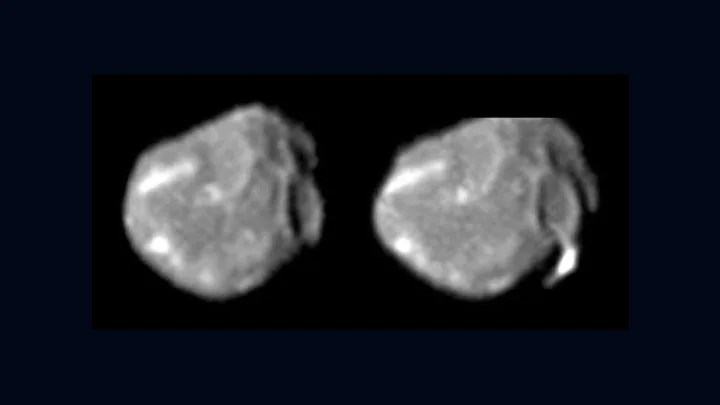
The Galileo Mission and the Amalthea Flyby
On November 5, 2002, NASA's Galileo spacecraft executed a key flyby of Jupiter's small moon Amalthea during its extended mission in the Jovian system. This encounter provided a unique opportunity to study the nature of Jupiter's inner moons.
Data gathered during Galileo's historic pass allowed astronomers to directly calculate Amalthea's mass and evaluate its physical properties.
Observational Data and Density Measurements
Gravitational and mass measurements acquired by the spacecraft uncovered a surprising structural reality. Analyses demonstrated that Amalthea is not a solid monolithic rock as previously assumed.
The data revealed that Amalthea's density is less than that of water, indicating it is essentially a porous, icy pile of rubble. This low density suggested that the moon assembled from fragments following ancient impact events.
Scientific Significance and Impact on Models
Amalthea's low density and rubble-pile structure introduced new constraints to theoretical models regarding the formation and evolution of inner moons. The finding prompted a re-evaluation of internal moon dynamics.
This landmark observation by Galileo continues to inform research and future mission planning aimed at exploring small moons and asteroids throughout the Solar System.

Comments
Loading comments...