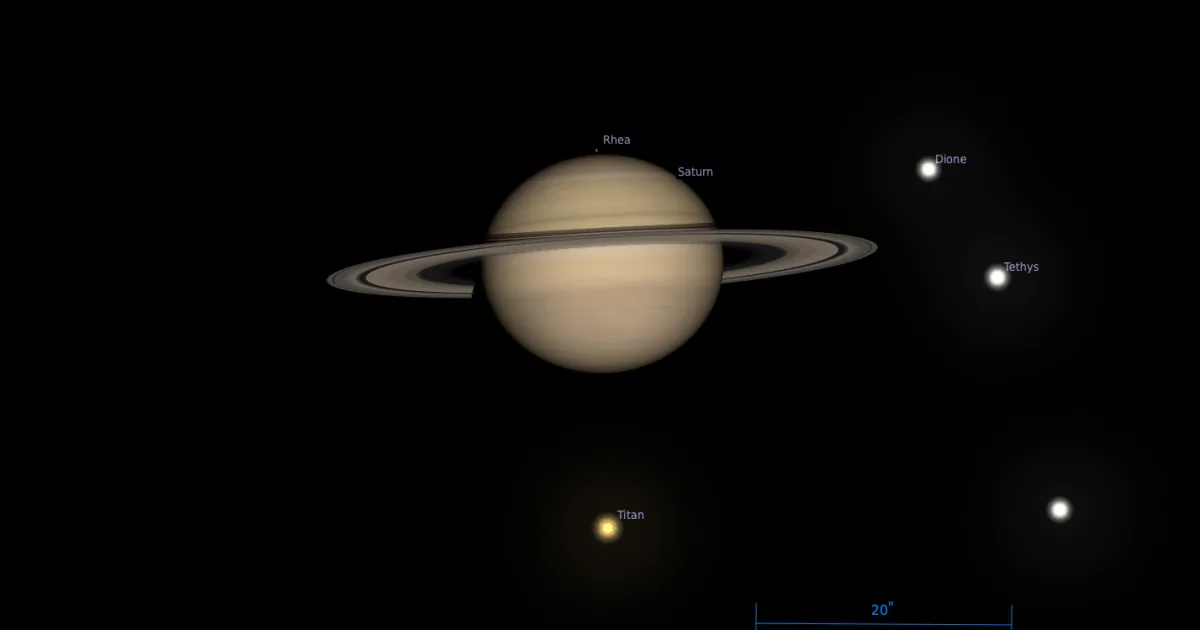
Saturn and Its Moons in the Night Sky
This week brings exciting opportunities for amateur astronomers and skywatchers. Positioned roughly 40 degrees high in the southeast about two hours after sunset, Saturn shines brilliantly, outshining other nearby celestial bodies. This favorable positioning allows observers to view both the planet and its prominent moons clearly.
Observation Details of Titan and Rhea
During the key observation period, Saturn's largest and brightest moon, Titan, can be spotted skimming just south of the gas giant. Meanwhile, Rhea takes up a position to the north of the planet. Additionally, the sky calendar highlights a notable conjunction between Mars and Jupiter occurring around November 15, adding to the weekly events.
Significance for Backyard Stargazing
Such distinct alignments of planets and their moons provide excellent conditions for observations using backyard telescopes or binoculars. Tracking Titan's position relative to Saturn helps stargazers better understand orbital dynamics while enjoying a striking view of the solar system's major bodies.

Comments
Loading comments...