Highlights of the Late November Night Sky
According to the skywatching guide published by Sky & Telescope, the period between November 20 and 29 offers brilliant observational opportunities for stargazers. As late autumn settles in, prominent celestial formations and dynamic planetary alignments become clearly visible to the naked eye or through modest binoculars.
The Full Moon, Pleiades, and the Pre-Dawn Triangle
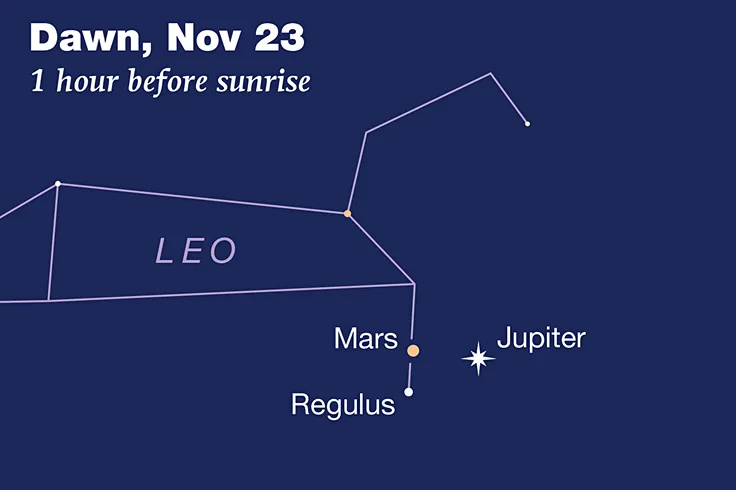
The late November Full Moon shines prominently near the Pleiades star cluster (also known as the Seven Sisters), one of the closest and brightest open clusters in the night sky. Meanwhile, in the hours before dawn, a striking high triangle formed by Jupiter, Mars, and the bright star Regulus in the constellation Leo continues to shift shape each morning due to the relative orbital motions of the planets.
Observational Tips and What to Look For
Observing these sky events requires no complex equipment. While the pre-dawn planetary triangle of Jupiter, Mars, and Regulus is easily seen with the naked eye above the eastern horizon, using a simple pair of binoculars helps cut through the Moon's glare to resolve the delicate stars of the Pleiades cluster nearby.
Comments
Loading comments...