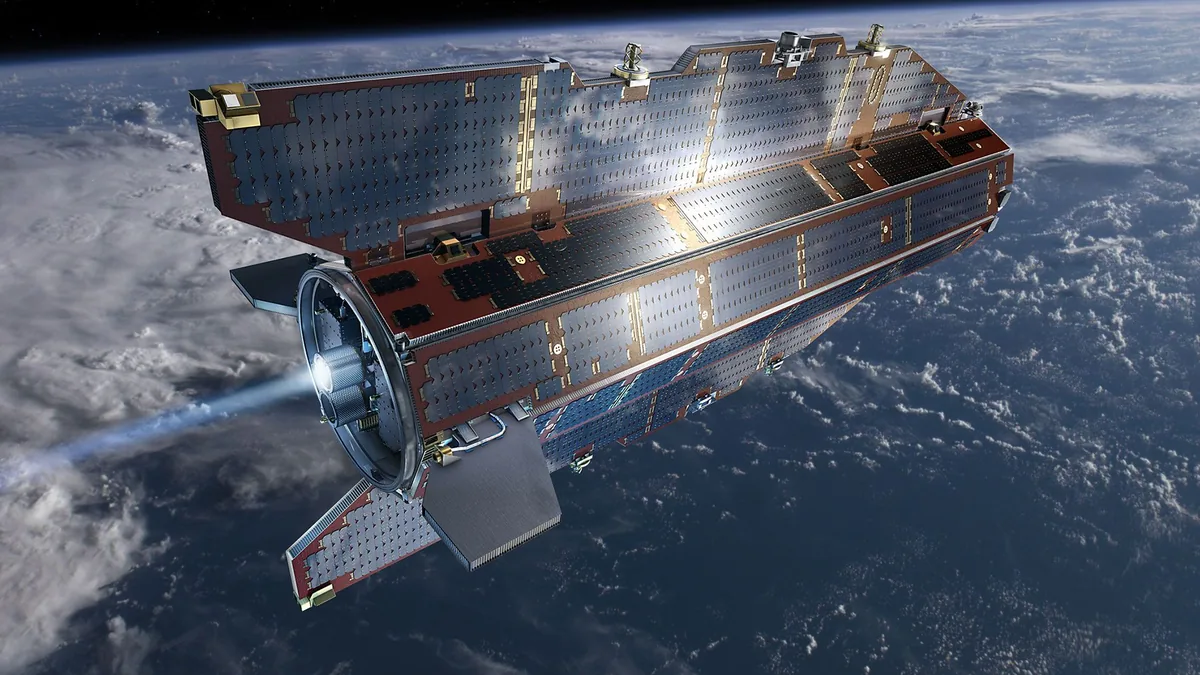
The GOCE Mission and the 'Ferrari of Space' Design
Developed by the European Space Agency (ESA), the GOCE satellite concluded its four-year mission on November 10, 2013, when it re-entered Earth's atmosphere and burned up safely. Dubbed the 'Ferrari of space' due to its sleek, aerodynamic body and stabilizing fins, the satellite stands out as one of the most iconic designs in the history of space engineering.
GOCE was launched to map Earth's gravitational field and geoid with unprecedented precision. Designed to operate in an exceptionally low orbit, the spacecraft featured an aerodynamic shape to withstand the drag caused by the faint upper layers of Earth's atmosphere. An advanced electric ion propulsion system continuously counteracted atmospheric drag in real time to maintain its orbital trajectory.
Gravity Field Measurements and Orbital Details
GOCE operated at an ultra-low altitude of approximately 260 kilometers, significantly lower than typical Earth observation satellites. At the core of the spacecraft was a highly sensitive 3D electrostatic gravity gradiometer capable of detecting minute fluctuations in Earth's gravitational pull. This instrument enabled scientists to measure subtle mass variations across the planet with extreme accuracy.
Throughout its four-year operational lifespan, GOCE generated a high-resolution map of Earth's geoid—the equipotential surface of the planet's gravity field. The precise measurements gathered by the satellite allowed researchers to study ocean circulation, sea level changes, ice sheet mass dynamics, and sub-surface tectonic structures in unprecedented detail.
Impact on Earth Sciences and Mission Legacy
The datasets gathered by GOCE revolutionized geodesy, oceanography, and geophysics. The definitive global gravity map created by the mission became an essential reference baseline for climate change research, enabling accurate modeling of heat transport through global ocean currents.
Following the depletion of its xenon fuel in October 2013, the satellite gradually lost altitude and made a re-entry into Earth's atmosphere on November 10, 2013. Disintegrating safely over the ocean, GOCE left behind an invaluable scientific legacy that continues to inform Earth science research today.
Comments
Loading comments...