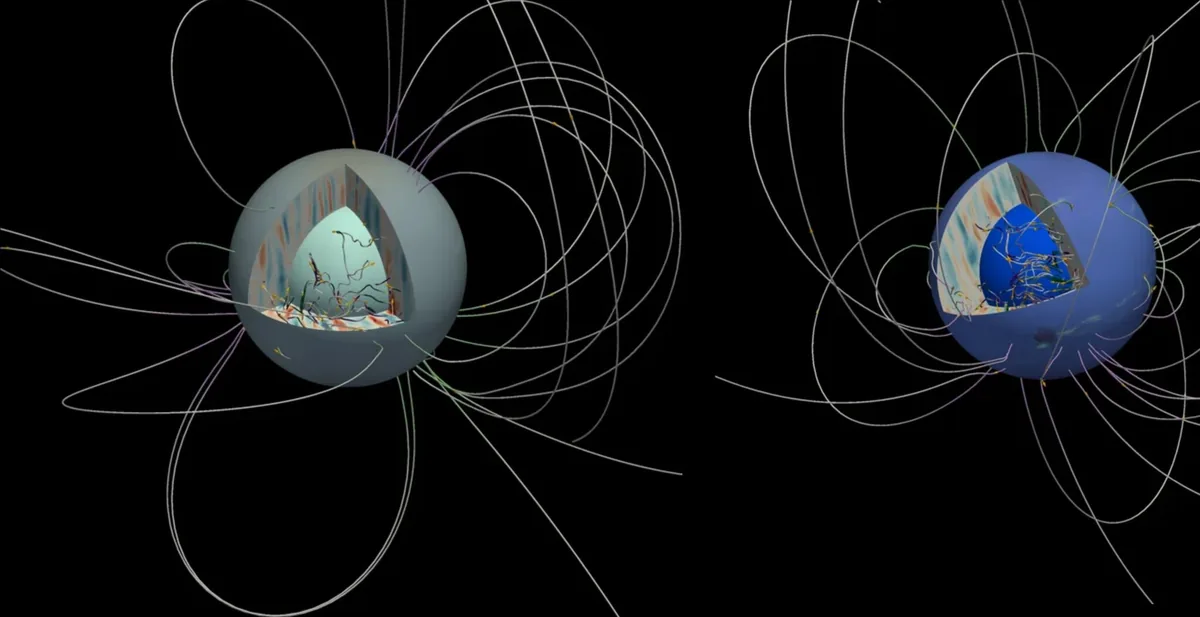
The Mysterious Magnetic Structure of Ice Giants
When NASA's Voyager 2 robotic probe flew by Uranus and Neptune in the 1980s during its historic journey through the outer Solar System, it uncovered a major planetary anomaly. Unlike Earth, which features a well-defined magnetic field with distinct north and south poles, the ice giants Uranus and Neptune exhibited magnetic fields that were highly disordered, asymmetric, and complex.
Deep Interior Conductivity Changes
Decades after Voyager 2 gathered these measurements, researchers continue to analyze the physical mechanisms responsible for this magnetic disarray. Recent studies suggest that these unusual magnetic fields likely stem from significant variations in electrical conductivity deep within the planets' interiors. As physical conditions shift in the deep layers of these ice giants, changes in conductivity alter how magnetic field lines are generated and shaped.
Scientific Implications and Future Planetary Missions
Understanding the magnetic field dynamics of Uranus and Neptune provides essential insights into planetary dynamo theory, internal heat flow, and interior composition. Resolving how deep conductivity changes dictate magnetic behavior helps refine models of planetary evolution both within our Solar System and for distant exoplanets. These findings will play a crucial role in planning future robotic missions targeted at exploring the outer ice giants in greater detail.


Comments
Loading comments...