Gravitational Lensing and Early Universe Observations
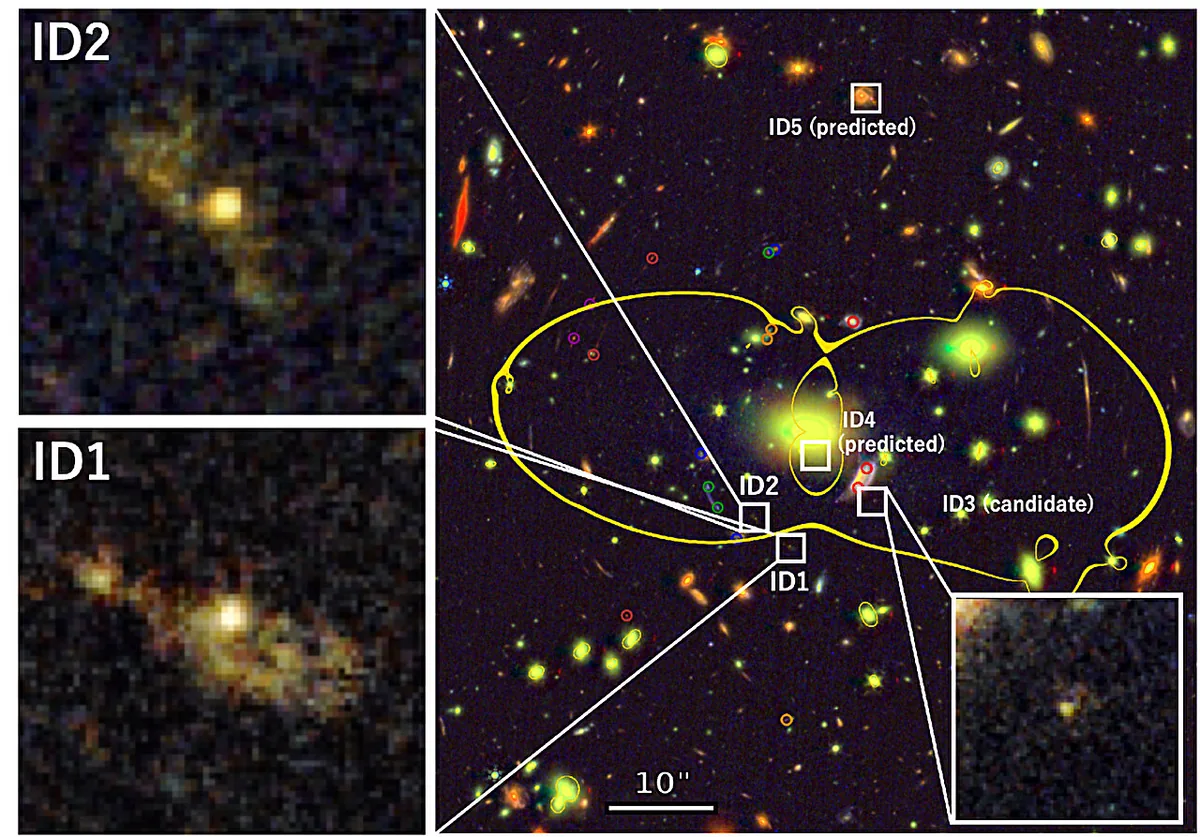
Gravitational lensing is considered one of the most effective techniques for astronomers seeking to study the early universe. In this process, a massive galaxy cluster situated between the observer and a distant object uses its gravitational power to bend and magnify the light from the background source, acting as a giant natural magnifying glass. Consequently, distant objects like the galaxy nicknamed Misty Moons, which would otherwise be far too faint to spot, suddenly come into view.
The Natural Magnifying Glass of Massive Clusters
The enormous mass of the intervening galaxy cluster warps space-time, enhancing the light flux from the distant object. Without this natural magnification, the Misty Moons galaxy would remain undetectable due to its faintness. The bending and amplification of light allow researchers to analyze the structural characteristics of such faint, distant systems in detail.
Implications for Star Formation Models
Observations of Misty Moons carry scientific significance for understanding how stars formed in early galaxies. The data gathered through gravitational lensing provides insights into the physical conditions and architecture of galaxies in the early universe, laying the groundwork for future deep-space observational campaigns.
Comments
Loading comments...