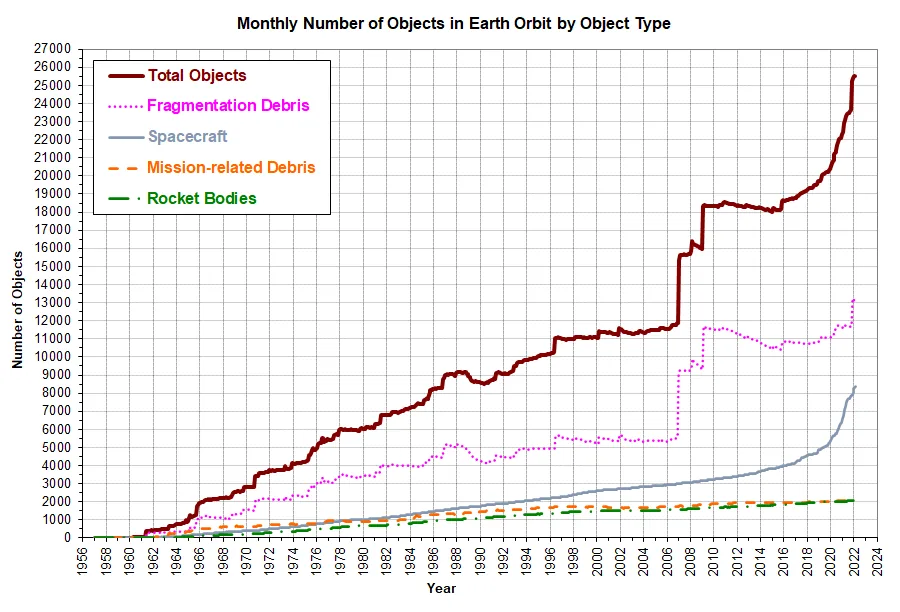
NASA's Primary Debris Model: LEGEND
The NASA Orbital Debris Program Office utilizes a 3D debris evolutionary model named LEGEND as its primary tool for studying long-term debris environment projections. LEGEND serves as a full-scale model designed to understand how human-made debris evolves in orbit over time.
This model plays a central role in analyzing space debris dynamics, providing critical projections for space mission safety and environmental monitoring in Earth orbit.
Extensive Altitude Coverage Across Earth Orbits
The LEGEND model covers near-Earth space between altitudes of 200 km and 50,000 km, capturing the regions most populated by artificial satellites and debris.
This altitude range encompasses low Earth orbit (LEO), medium Earth orbit (MEO), and geosynchronous orbit (GEO), providing a comprehensive three-dimensional view of space debris across multiple orbital regimes.
Scientific Significance of Debris Evolution Modeling
By simulating space debris evolutionary processes in three dimensions from 200 to 50,000 km, LEGEND offers essential insights into how the orbital environment will change over the long term.
These long-term projections enable NASA to better assess potential risks to active space assets and inform future space debris management strategies.
Comments
Loading comments...