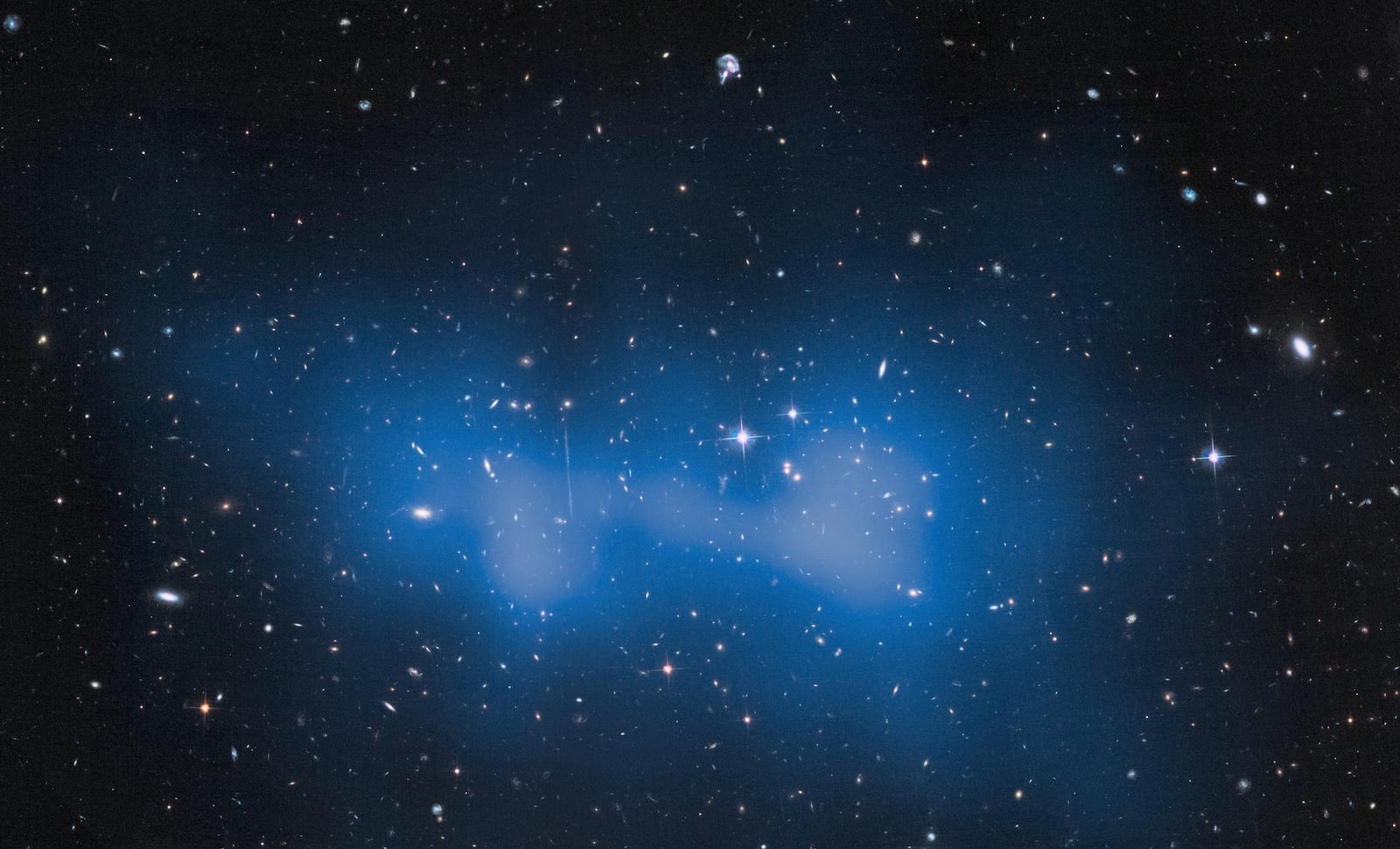
A Colossal Structure in the Distant Universe: El Gordo
Located in the distant cosmos, the El Gordo galaxy supercluster (officially designated ACT-CL J0102-4915) harbors an unusually enormous mass given its cosmological redshift. Standard cosmological frameworks struggle to fully reconcile how such a massive structure could assemble so rapidly in the relatively early history of the universe.
Astronomers have long analyzed El Gordo's gravitational lensing and collisional dynamics to determine whether this extreme system exposes flaws in our current understanding of cosmic structure growth.
The Nature of Dark Matter and Two-State Self-Interactions
Under the prevailing Cold Dark Matter (CDM) model, dark matter is assumed to be collisionless, interacting almost entirely through the force of gravity. However, to account for the anomalous mass accumulation rate seen in El Gordo, emerging theoretical studies propose that dark matter may be self-interacting (SIDM).
In this framework, dark matter particles interact via a novel two-state mechanism. This energy-dependent interaction allows cross-sections that facilitate faster local collapse and structural coalescence, enabling massive galaxy clusters to form much earlier than conventional collisionless scenarios predict.
Cosmological Implications and Observational Tests
Applying a self-interacting dark matter model to extreme clusters like El Gordo represents a pivotal step toward deciphering the microphysics of the universe's missing mass. Confirmation of such dynamics would indicate that dark matter possesses rich particle-level interactions beyond simple gravitational attraction.
Future deep-field observations and high-resolution gravitational lensing surveys will investigate additional high-redshift superclusters, directly testing whether this two-state interaction model consistently explains the accelerated growth of cosmic giants.


Comments
Loading comments...