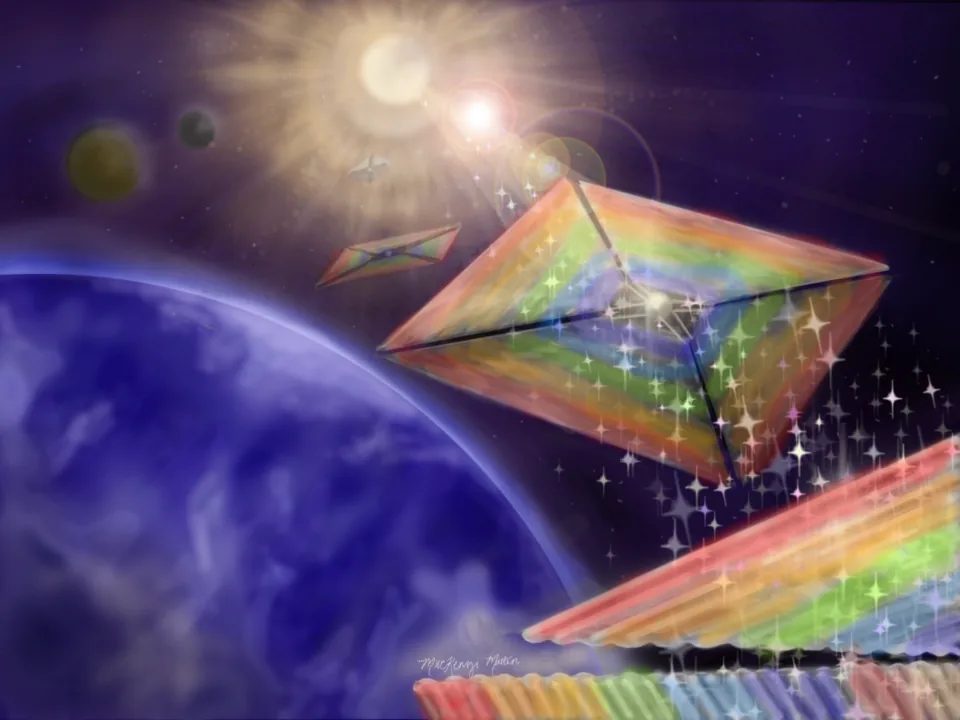
A New Era for Sailing on Sunlight
For years, space enthusiasts have dreamed of traversing the cosmic void aboard craft propelled by beams of sunlight. Photons, the massless particles constituting sunlight, carry momentum that imparts a subtle push when bouncing off surfaces. This physics principle forms the core of solar sailing, a concept proven feasible by several demonstration flights over the past decade. Now, researchers at the Rochester Institute of Technology (RIT) have introduced a novel technique in a pre-print paper on arXiv that promises to significantly enhance solar sail navigation.
Steering Innovation Inspired by Display Technology
The clever technique unveiled by the RIT team enables these massive sails to steer sideways by employing technology traditionally associated with flat-screen displays. Standard solar sails rely on direct photon reflection, which limits directional control without mechanical tilting. By precisely controlling light refraction and reflection across the sail surface, this display-inspired approach allows spacecraft to maneuver laterally without expending conventional propellant.
Scientific Impact and Future Space Applications
These ultra-thin "rainbow" sails hold transformational potential not only for deep space propulsion, but also for theoretical planetary shading initiatives aimed at managing solar radiation. The ability to dynamically alter sail trajectory expands the flexibility of long-duration interplanetary missions. The research team envisions that refining this technology could eventually establish passive light-driven propulsion as a primary system for future deep space exploration craft.

Comments
Loading comments...