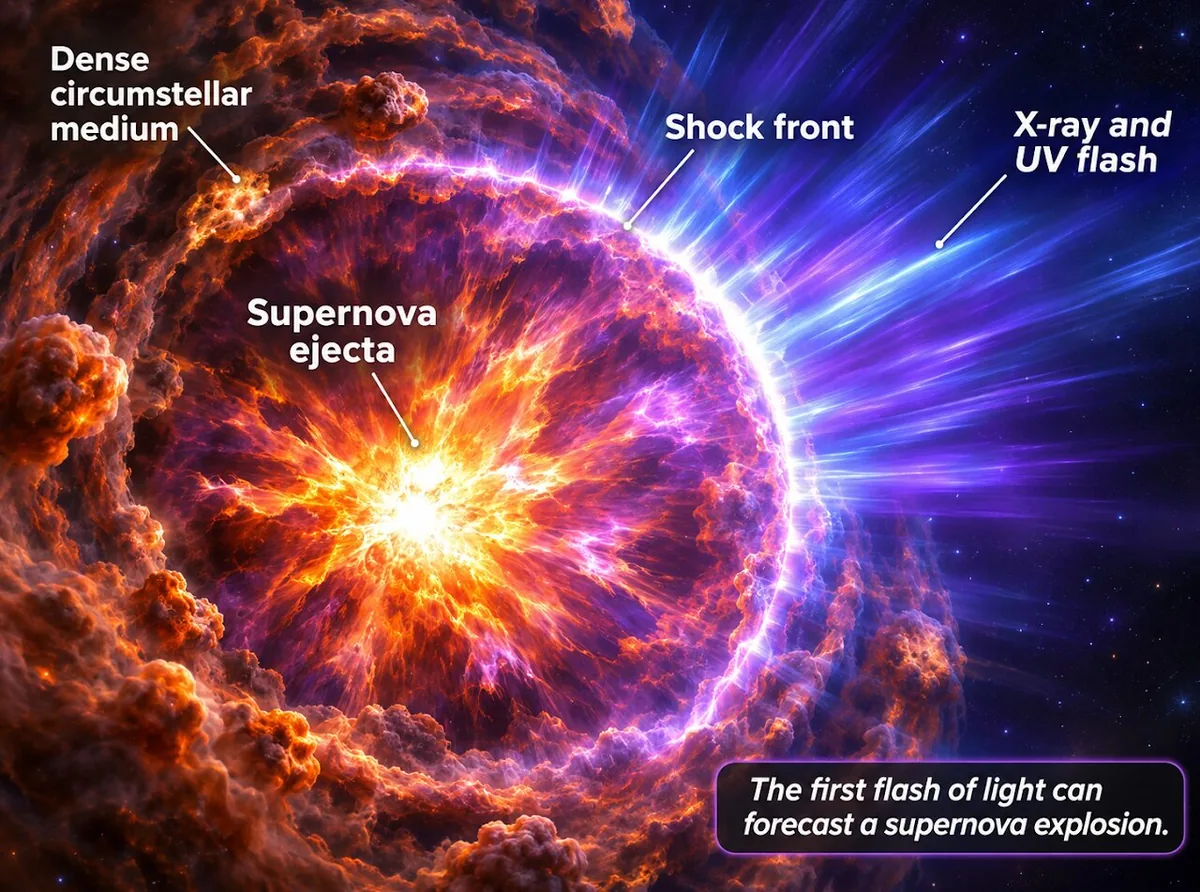
The Initial Signal of a Dying Star
When a massive star reaches the end of its life, the universe does not always announce the event with a slowly expanding supernova glow. Instead, the very first signal can be a dazzling, short-lived flash of invisible light that lasts for only a few hours. This phenomenon acts as a cosmic camera flash at the exact moment of destruction.
Gas Clouds and Light Propagation
This fleeting moment provides an unusually direct glimpse of the star at the instant of its collapse. However, astronomers must account for how this initial burst of light fights its way through dense clouds of gas expelled by the star just prior to its death, altering the observed light signal.
Mapping Hidden Stellar Surroundings
Analyzing how this brief light flash traverses the surrounding material reveals the structure and density of matter shed in the star's final stages. These transient flashes offer vital clues to refine models of stellar evolution and understand pre-supernova mass-loss mechanisms.
Comments
Loading comments...