Discovery of the Unseen Companion
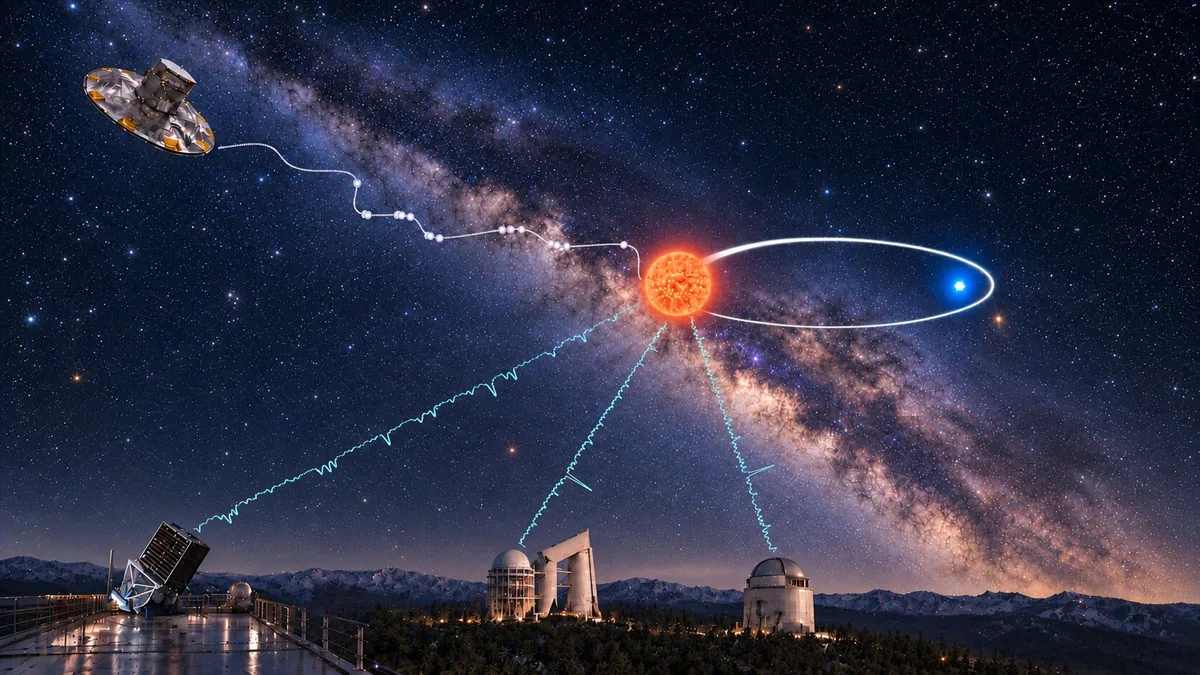
A team of astronomers has identified a unique binary system that could challenge current understanding of stellar mass boundaries. By analyzing data from large-scale astronomical surveys, researchers detected an unseen companion orbiting a red giant star. The discovery was made by combining observations from two major spectroscopic efforts.
The research team utilized data from the Large Sky Area Multi-Object Fiber Spectroscopic Telescope (LAMOST) and the Apache Point Observatory Galactic Evolution Experiment (APOGEE). Although the companion object cannot be observed visually, its existence was confirmed through the clear gravitational influence it exerts on the primary red giant star.
Observational Data and Gravitational Effects
Because the secondary object emits no detectable optical light, astronomers relied on indirect spectroscopic measurement techniques. By examining the radial velocity shifts and spectral characteristics of the red giant, the team carefully mapped the dynamics of the binary orbit.
The gravitational pull exerted on the red giant star indicates that the unseen companion possesses a significant amount of mass. The measured gravitational perturbation provides strong evidence for a highly massive compact object lurking in the binary system.
Scientific Significance and Astrophysical Impact
This discovery has major implications for astrophysics, as it may help bridge the long-standing 'mass gap' between the heaviest neutron stars and the lightest black holes. Identifying a candidate supermassive neutron star provides crucial empirical constraints for compact object formation theories.
Understanding the properties of such binary systems improves stellar evolution models and supernova remnant classifications. Astronomers plan to perform follow-up spectroscopic measurements to further constrain the mass and exact nature of this companion.

Comments
Loading comments...