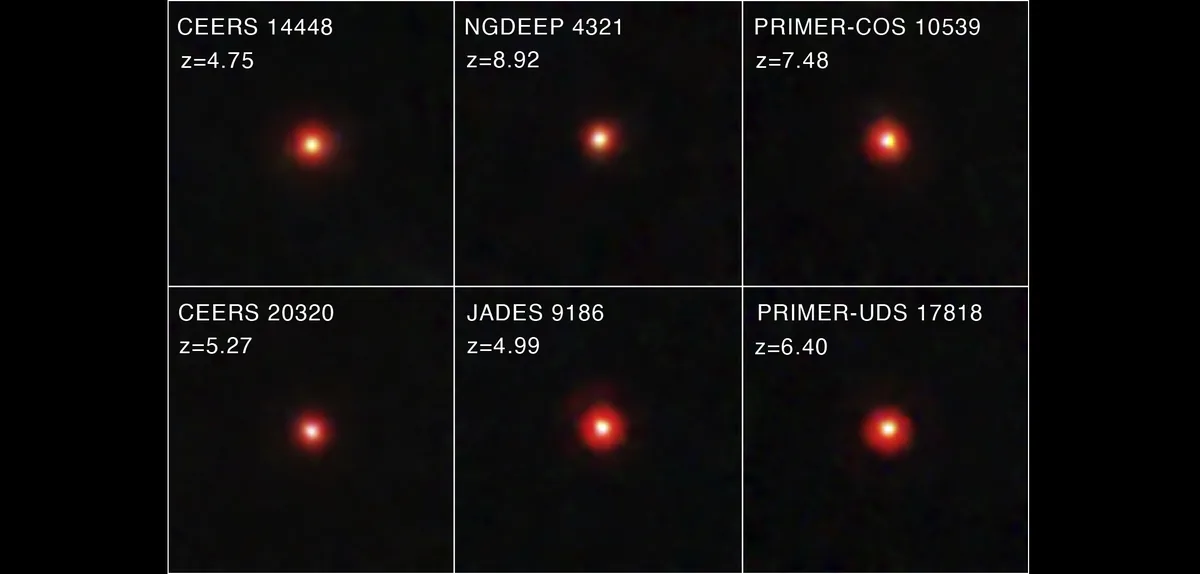
Mysterious Objects Discovered by JWST
Deep-field observations conducted by the James Webb Space Telescope (JWST) uncovered a class of highly unusual objects in the early universe. Referred to by astronomers as "little red dots," these compact, extremely luminous red sources presented a puzzling challenge to standard models of early galactic and black hole formation.
Supercritical Accretion Mechanics
New constraints published in AAS Nova shed light on the physical drivers behind these enigmatic dots. Theoretical analysis demonstrates that supercritical accretion—a process where black holes feed on surrounding matter at rates exceeding the conventional Eddington limit—may actively drive the intense luminosity and distinct spectral properties of these objects.
Implications for Early Supermassive Black Holes
Understanding these constraints provides a viable pathway to explaining how supermassive black holes attained massive sizes so early in cosmic history. If verified through ongoing JWST spectroscopic follow-ups, the supercritical accretion framework will redefine our understanding of black hole growth and galaxy co-evolution in the early universe.

Comments
Loading comments...