Fermi Space Telescope Detects Unusual Gamma-Ray Burst
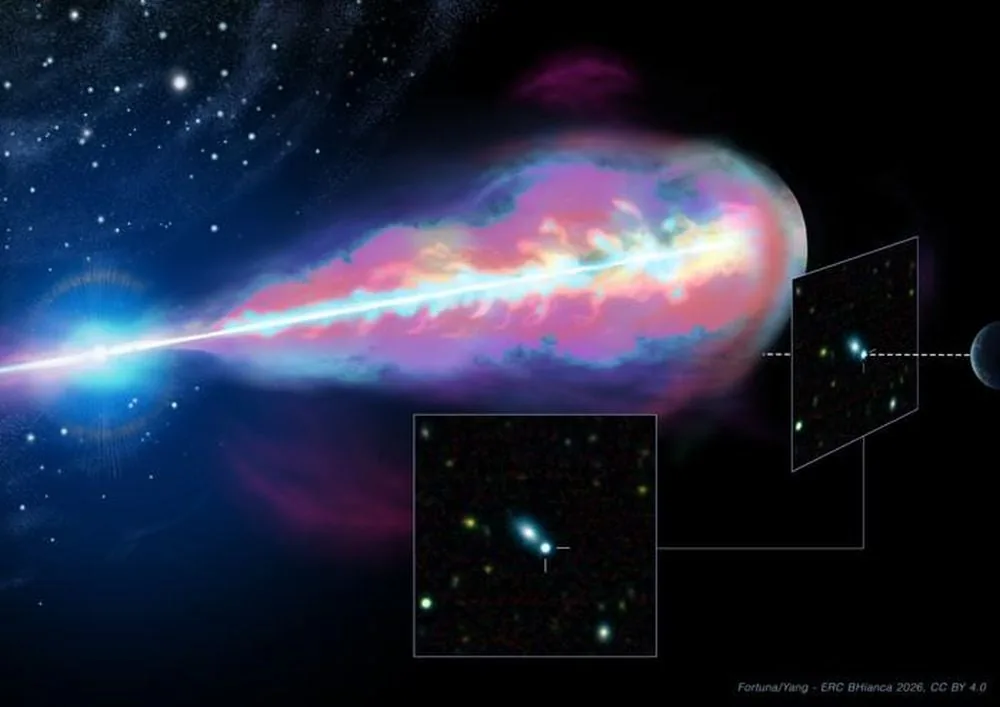
In March 2026, NASA's Fermi Gamma-ray Space Telescope registered a gamma-ray burst (GRB) displaying a highly unusual light signature. Initially, the outburst's primary gamma radiation appeared surprisingly dim, leading to questions regarding the true scale of the cosmic event. Subsequent observations revealed unexpected, delayed peaks in its afterglow intensity.
Astronomers initiated comprehensive analytical modeling to decipher the strange light curve. The resulting data provided a coherent explanation for the peculiar behavior of this high-energy blast.
Side Angle Viewing and Extreme Energy Concentration
Detailed physical analysis revealed that the initial low brightness was an effect of viewing geometry. Astronomers were observing the relativistic jet from a side angle rather than head-on along its central axis, causing the primary radiation to appear muted while delaying the peak afterglow signals.
Correcting for this viewing angle demonstrated the immense intrinsic power of the burst. The explosion packed an amount of energy equivalent to one billion years of the Sun's total energy output, focusing it entirely into an extremely narrow relativistic beam.
Refining Astrophysical Models of GRB Jetted Emission
This finding highlights how significantly viewing angle can distort the observed brightness and evolution of cosmic gamma-ray bursts. Bursts that appear intrinsically faint may actually represent ultra-powerful events directed slightly away from Earth's line of sight.
Data gathered by the Fermi Space Telescope will help refine theories regarding jet collimation and stellar collapse mechanics. Researchers plan to apply these geometric models to other historically misunderstood gamma-ray bursts.

Comments
Loading comments...