Neutron Stars and an Unusual Slowdown
Pulsars are extremely dense neutron star cores left behind when massive stars end their lives in powerful supernova explosions. Rotating at extraordinary speeds, these celestial objects are considered among the universe's most precise cosmic clocks. However, when astrophysicists recently examined a specific pulsar spinning over 300 times per second, they encountered an unexpected phenomenon. The pulsar appeared to be slowing down unusually quickly compared to typical rotation models.
Precise Measurements and Evidence of a Trio
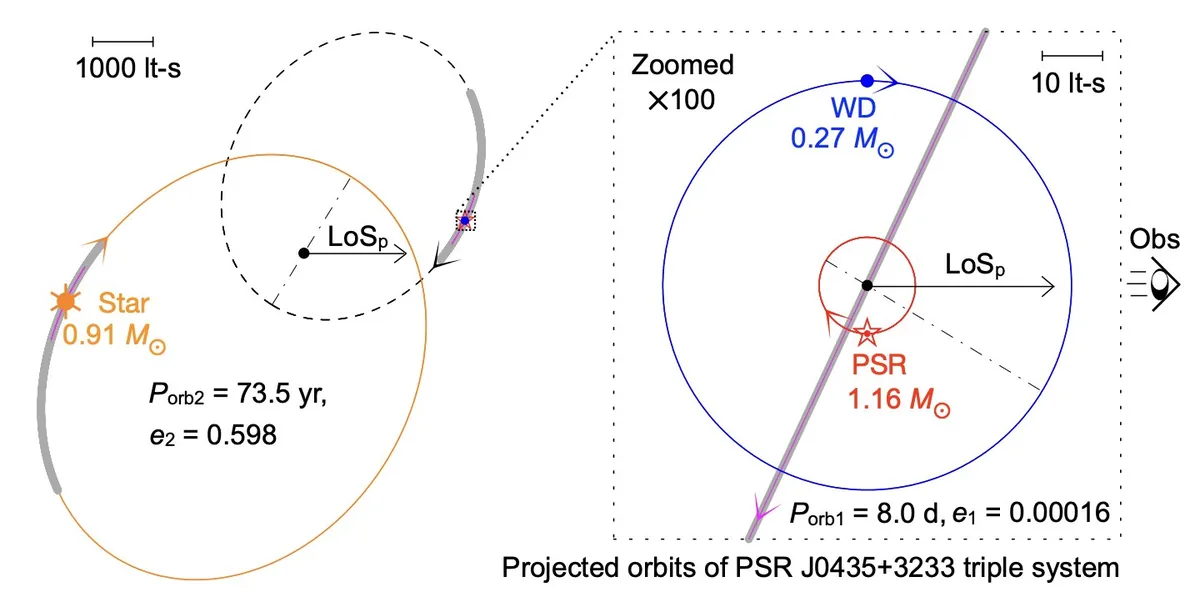
Detailed astronomical observations and timing measurements revealed that this rapid decrease in rotational speed could not be explained by the internal dynamics of a single isolated star. Investigating the anomaly in its rotational period, researchers analyzed the subtle gravitational forces influencing the pulsar's motion. The collected data demonstrated that behind this apparent slowdown lay the gravitational influence of a rare stellar triple system rather than a solitary object.
Implications for Astrophysics and Future Observations
This discovery provides valuable insights into how dense stellar cores behave within complex, multi-body gravitational environments. Rare stellar trios offer astrophysicists a unique natural laboratory to test theories of gravitation and neutron star evolution. The research team plans to conduct further observations to map the system's precise gravitational architecture and better understand the dynamic interactions between the three stars.

Comments
Loading comments...