The Decades-Long Mystery Over Arsia Mons
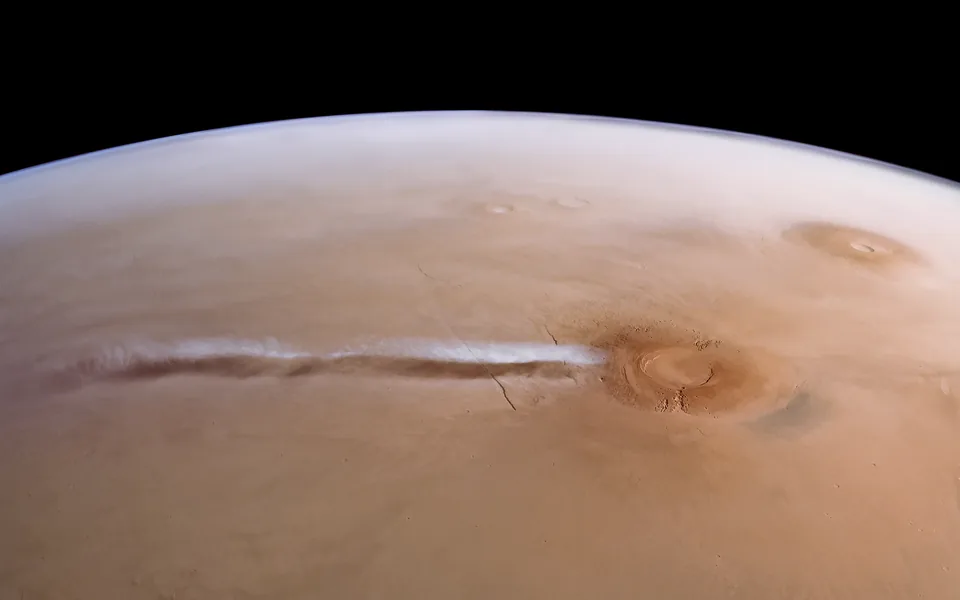
Just like Earth, Mars experiences distinct seasons that give rise to fascinating atmospheric phenomena. During each summer on the Red Planet, an extraordinary meteorological feature emerges to the west of Arsia Mons, a massive 20-kilometer-high extinct shield volcano. Spanning an astonishing 1,800 kilometers in length, this thin white plume materializes every single morning, lingers for only a few hours, and then dissipates before repeating the cycle the following day. Known to planetary scientists for decades as the Arsia Mons Elongated Cloud (AMEC), this striking atmospheric formation has persistently resisted explanations based on conventional atmospheric models.
Observations and the Flash-Freezing Hypothesis
A research team led by Dr. Jorge Hernández-Bernal from Sorbonne University has offered a groundbreaking solution to this enduring puzzle in a study published in Nature Geoscience. While traditional atmospheric physics and textbook condensation pathways have repeatedly struggled to replicate the formation of the AMEC, the new findings suggest that this phenomenon may be the very first documented real-world case of a cloud flash-freezing directly out of thin air. In the rarefied Martian atmosphere, air parcels driven upward by the towering topography of the extinct shield volcano rapidly encounter extreme cooling, causing ambient water vapor to freeze almost instantaneously into ice crystals.
Implications for Planetary Climate Models
These findings not only clarify one of the most enigmatic cloud features observed on Mars, but also provide crucial insights into atmospheric physics across terrestrial worlds. The realization that clouds can spontaneously flash-freeze in low-density planetary environments challenges conventional modeling frameworks and reveals how delicate the seasonal water cycle on the Red Planet truly is. The analysis led by Dr. Hernández-Bernal provides a critical benchmark for future orbital observations and will help planetary scientists refine global climate simulations for Mars as exploration continues.
Comments
Loading comments...