The Quest for the Cosmic Missing Link in the Early Universe
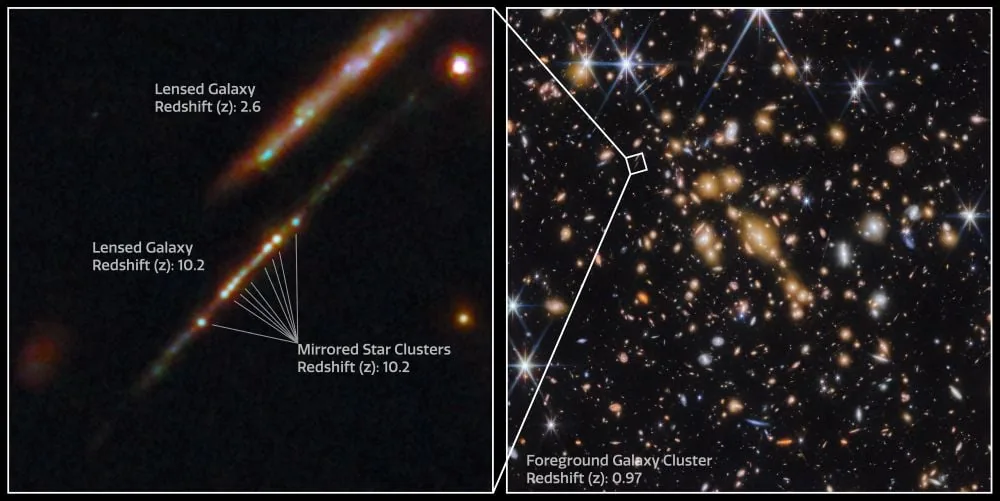
Astrophysicists widely hypothesize that black holes grow over cosmic time through a hierarchical merger framework. However, intermediate-mass black holes (IMBHs) have long represented a critical missing link between ordinary stellar-mass remnants and the supermassive titans anchoring galaxies like the Milky Way. Observations from the James Webb Space Telescope (JWST) have now identified potential ancient cradles where these elusive heavy seeds may have first materialized.
Young Massive Clusters Detected at High Redshifts
Utilizing JWST's high-resolution infrared capabilities to peer into the high-redshift Universe, researchers identified energetic environments hosting young massive clusters. These dense stellar environments provide the extreme gravitational conditions required for runaway mergers and rapid core collapses. The data indicates that such compact clusters are the primary candidates for harboring the ancient, heavy black hole seeds that subsequently seeded subsequent cosmic growth.
Implications for Supermassive Growth and Cosmological Frameworks
Identifying the birthplace of heavy seeds offers a direct solution to how supermassive black holes formed so rapidly in the epoch following the Big Bang. By confirming that high-redshift star clusters act as nursery grounds for intermediate seeds, the findings reconcile observational data with theoretical merger models. Future JWST spectroscopy campaigns will focus on probing the internal kinematics of these clusters to measure seed masses with greater precision.
Comments
Loading comments...