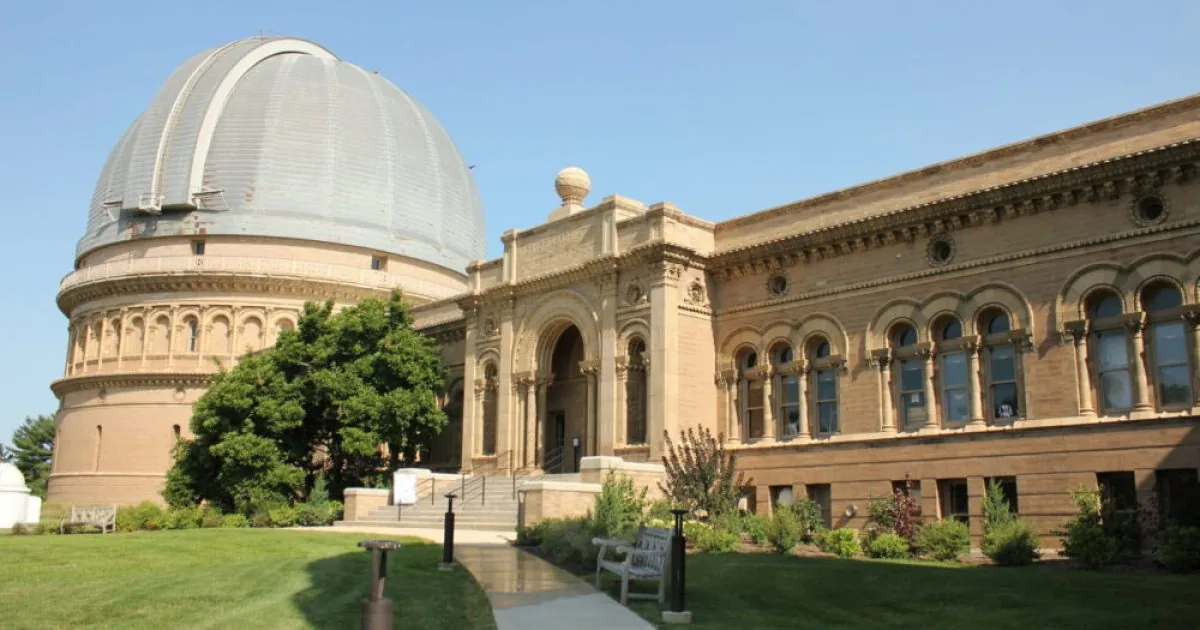
The Inception of a Grand Astrophysical Vision
In 1892, George Ellery Hale, an astrophysics professor at the University of Chicago, successfully convinced the university president to acquire two 40-inch telescope lens blanks. Realizing the immense scientific potential, Hale sought external backing to construct a facility grand enough to support them, eventually partnering with Chicago mass-transit magnate Charles Yerkes, who was eager to rehabilitate his public standing.
Engineering the Great Refractor
Backed by Yerkes' funding, Hale spearheaded the architectural and technical realization of the observatory designed specifically to house the Great Refractor. Built around the pair of 40-inch glass blanks, the instrument stood as a pinnacle of late-nineteenth-century optical engineering, pushing refractor telescope technology to its theoretical and physical limits.
A Landmark Milestone for Observational Science
Officially dedicated on October 21, 1897, Yerkes Observatory marked a pivotal transition in astronomical research. Hale's leadership and the institutional scale of the observatory established a foundational model for large-scale astrophysical research facilities throughout the modern era.



Comments
Loading comments...