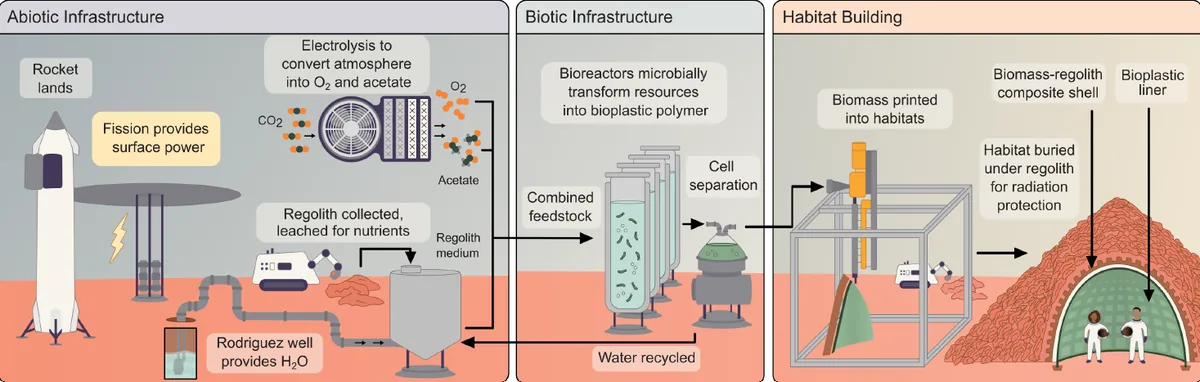
Autonomous Habitat Concept on the Red Planet: Mars Seed
As humanity prepares to eventually land a human on Mars, innovative ideas are emerging about how to construct safe shelters before astronauts arrive. Pioneer Labs, a research institute founded by bioengineer Erika DeBenedictis to develop biological technologies for space exploration, has detailed a new architecture called "Mars Seed." Funded by The Astera Institute and published on arXiv under their Open Science policy, the study outlines a self-contained system designed to construct habitats on the Martian surface autonomously.
Building Structures via Biological Processes and Nuclear Power
The proposed "Mars Seed" architecture relies on a completely self-contained design. By combining nuclear power with bacterial processes, the system eliminates the need to transport heavy construction materials from Earth, using nothing but local Martian inputs. According to the research, this system is capable of producing a full 870 square meters of pressurized habitat space roughly every four Earth years, fully preparing the site before human crews land.
Significance for Future Interplanetary Missions
Combining in-situ resource utilization with synthetic biology has the potential to significantly reduce the cost and technical risk of future Mars missions. By sharing this proposal transparently as part of an open science initiative, the researchers offer a realistic biotechnological blueprint to solve one of the greatest obstacles to establishing a permanent human presence on Mars: constructing pressurized, ready-made habitats prior to human arrival.
Comments
Loading comments...