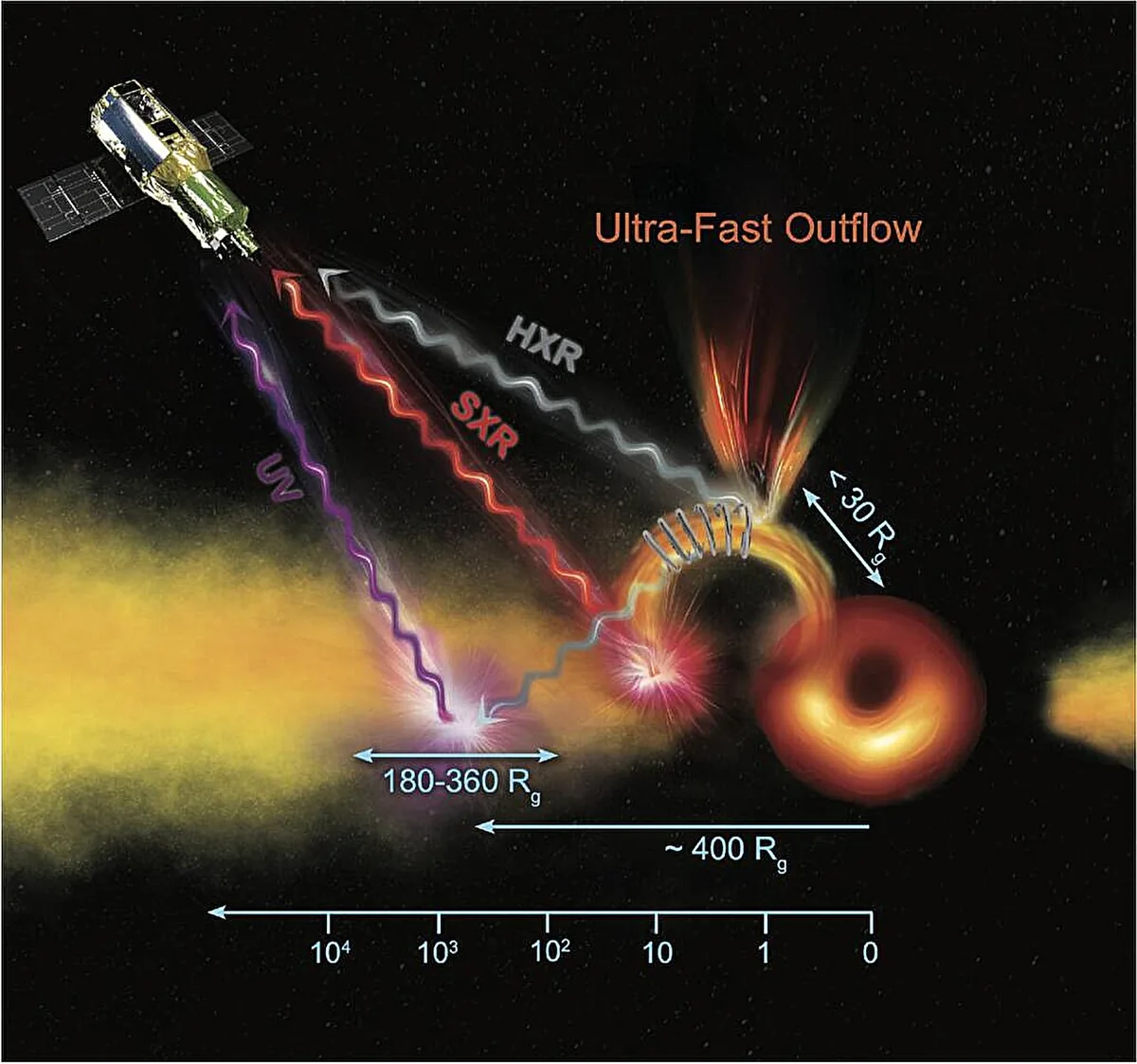
Enormous Eruptions Around Supermassive Black Holes
Researchers at the Technion – Israel Institute of Technology have presented compelling evidence of massive outbursts near supermassive black holes that closely resemble solar storms. Occurring around black holes that can be more than a million times more massive than our Sun, this phenomenon provides crucial insight into how these extreme objects interact with their surrounding environments. The groundbreaking findings were published in The Astrophysical Journal Letters.
Observations and Spectral Data from Galaxy NGC 3783
The team discovered this phenomenon in the immediate vicinity of the active supermassive black hole located at the center of the galaxy NGC 3783. By analyzing light emission and spectral measurements from the superheated accretion disk surrounding the black hole, researchers traced high-energy plasma outflows driven by magnetic reconnection event mechanisms. The data indicates that these eruptions operate via physical processes analogous to solar magnetic storms, but on an exponentially larger galactic energy scale.
Impact on Galactic Evolution and Astrophysical Models
This discovery holds significant implications for understanding the evolution of galaxies harboring active supermassive black holes at their cores. The violent ejection of energy and magnetic plasma from black holes can regulate or suppress star formation throughout host galaxies. Moving forward, the research team aims to conduct follow-up observations across other active galactic nuclei using high-energy space observatories to determine how widespread these magnetic storm-like eruptions are.
Comments
Loading comments...