
Background of the Discovery and Research Team
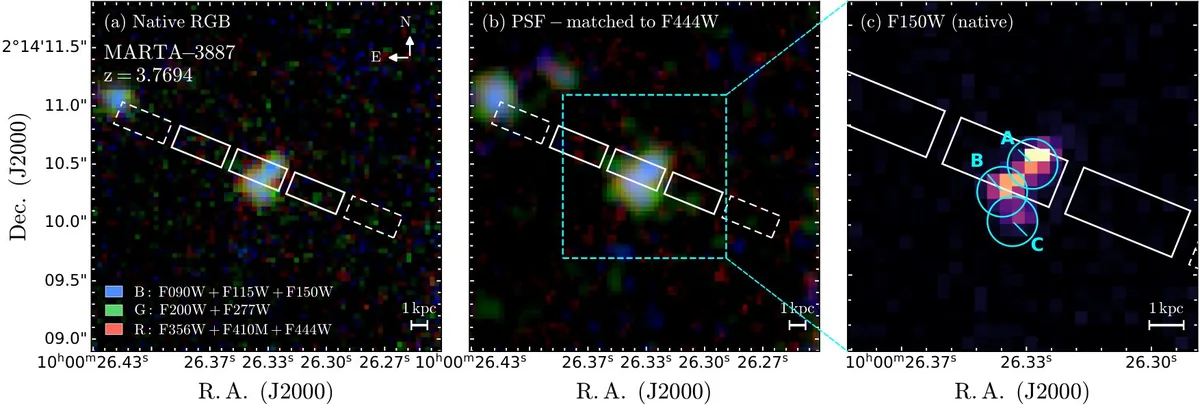
An international team of astronomers led by Julien Wolf, a postdoctoral researcher at the Max Planck Institute for Astronomy (MPIA) in Heidelberg, Germany (currently based at the European Southern Observatory in Garching bei München, Germany), has made a record-breaking discovery. The team identified the most distant quasar observed to date, shedding new light on the early epoch of the cosmos.
This historic object was initially flagged in data collected during the Euclid Wide Survey (EWS). The discovery highlights the formidable capability of space-based wide-field surveys in probing the distant and ancient universe.
Observational Details and Multi-Telescope Verification
Following its initial identification in the Euclid Wide Survey data, the candidate object underwent detailed verification using some of the world's most advanced observatories. A series of follow-up observations were conducted utilizing powerful ground-based and space-based telescopes.
High-precision spectroscopic measurements across multiple wavelengths confirmed the candidate's nature as an exceptionally distant quasar powered by a supermassive black hole. The combined observational campaign provided conclusive evidence validating the object's unprecedented distance.
Scientific Significance and Black Hole Formation Scenarios
Finding the most distant quasar to date places stringent theoretical constraints on how supermassive black holes could form and grow so rapidly in the early history of the universe. This record tightens existing physics and cosmological models governing black hole seed growth.
As a pivotal milestone in observational cosmology, this discovery sets a new benchmark for understanding the early universe. Researchers plan to leverage data from Euclid and other premier space and ground observatories to identify further extreme objects at cosmic dawn.
Comments
Loading comments...