Overcoming the Physical Limits of Rocket Fairings
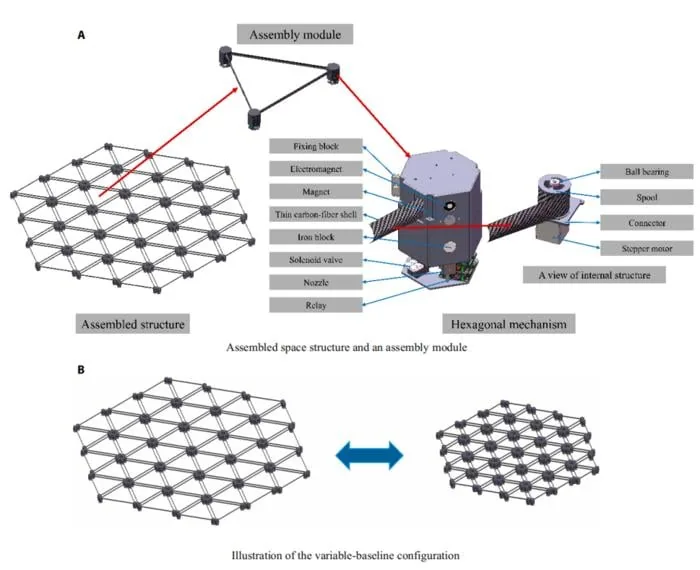
While private companies are launching increasingly massive payloads using larger rockets, the size of objects that can be placed into orbit remains heavily constrained by payload fairing dimensions. This physical barrier severely limits the maximum scale of critical space infrastructure, such as massive communications arrays or space-based solar power satellites. To address this fundamental engineering challenge, researchers from Nanjing University of Aeronautics and Astronautics and the Beijing Institute of Technology have proposed a novel self-shaping, deployable modular solution.
Autonomous Triangular Modules and Fine-Tuning Capabilities
The innovative design presented by the research team relies on autonomous triangular modules that can assemble themselves directly in space. This system is capable of precisely fine-tuning both its orbital positioning and its own physical dimensions. By remaining stowed compactly during launch and deploying once in orbit, the structural components can expand to form massive space platforms. This approach eliminates the need for manual human assembly or overly complex robotic arm systems during orbital construction.
The Future of Space Architecture and Mega-Observatories
This modular approach opens new horizons for the construction of future mega space observatories and giant orbital structures. By bypassing conventional rocket payload fairing constraints, it becomes feasible to construct space telescopes with apertures spanning hundreds of meters. The research team plans to advance to prototype testing phases to evaluate how these autonomous modules can transform space architecture, deep-space observation missions, and interplanetary communication networks.

Comments
Loading comments...