PGC 44685 and the Role of Wolf-Rayet Stars
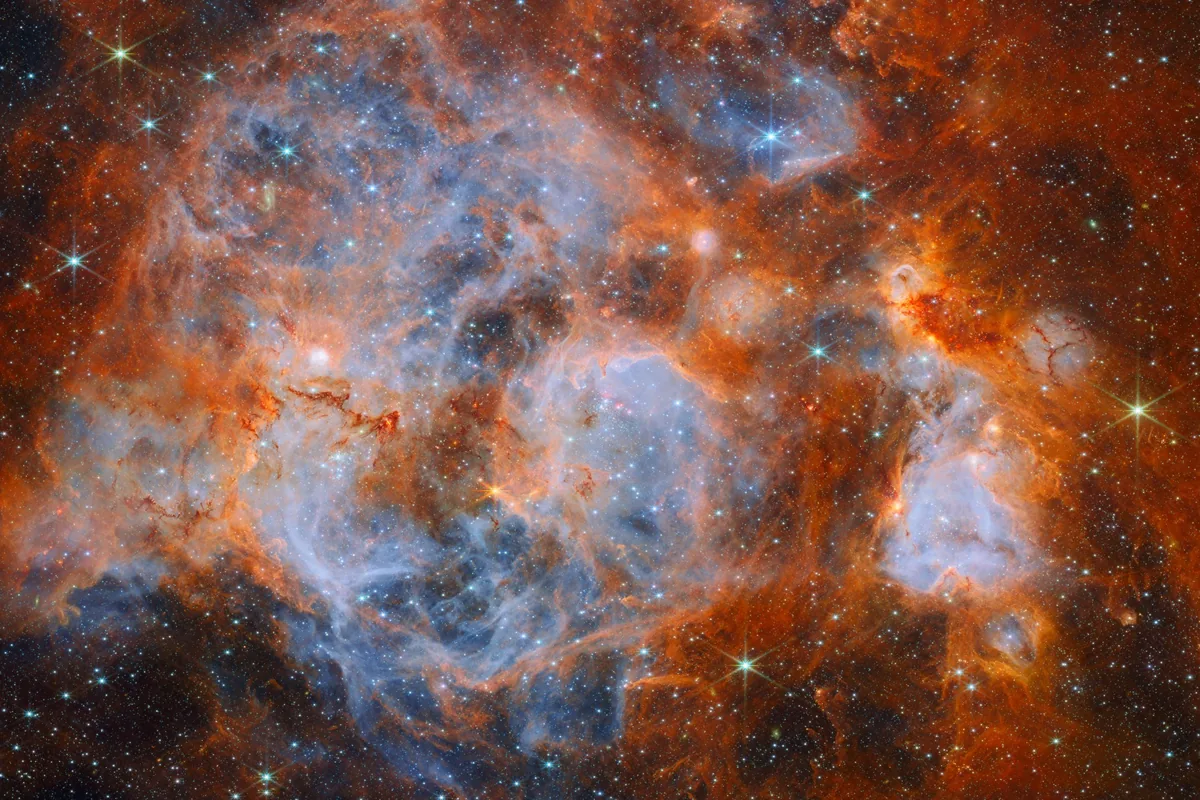
Located in the galactic neighborhood, the dwarf galaxy PGC 44685 hosts Wolf-Rayet stars, which are among the most massive and luminous stars known in the universe. In the final stages of their evolution, these stars shed immense amounts of mass through high-velocity stellar winds. A research team targeted PGC 44685 to determine how these powerful outflows influence the surrounding interstellar medium.
Dwarf galaxies provide ideal natural laboratories for studying stellar feedback due to their relatively shallow gravitational potential wells. Scientists sought to verify whether the kinetic energy from Wolf-Rayet stars could impact gas dynamics across the entire galaxy.
Observational Data and Subkiloparsec Scale Findings
Spectroscopic observations and photometric measurements revealed clear evidence of material being pushed outward by Wolf-Rayet stellar winds on subkiloparsec scales (regions smaller than a thousand light-years). These winds actively carve out and shape the gas structures in the immediate vicinity of the stars.
However, the detailed spectral data highlighted an important physical limitation: despite their localized intensity, these stellar winds are unable to drive galaxy-wide outflows. The observed outflow phenomena remain confined to subkiloparsec scales rather than affecting the galaxy as a whole.
Implications for Galactic Evolution Models
These findings provide critical empirical constraints on stellar feedback models used in galactic astrophysics. Theoretical assumptions that stellar winds alone can easily clear gas from dwarf galaxies must be refined to account for localized containment.
Astronomers plan to conduct follow-up observations on additional nearby dwarf galaxies to compare the combined effects of Wolf-Rayet stars and supernovae on large-scale interstellar matter distribution.
Comments
Loading comments...