A Deep Look into the Dragon Galaxy with JWST
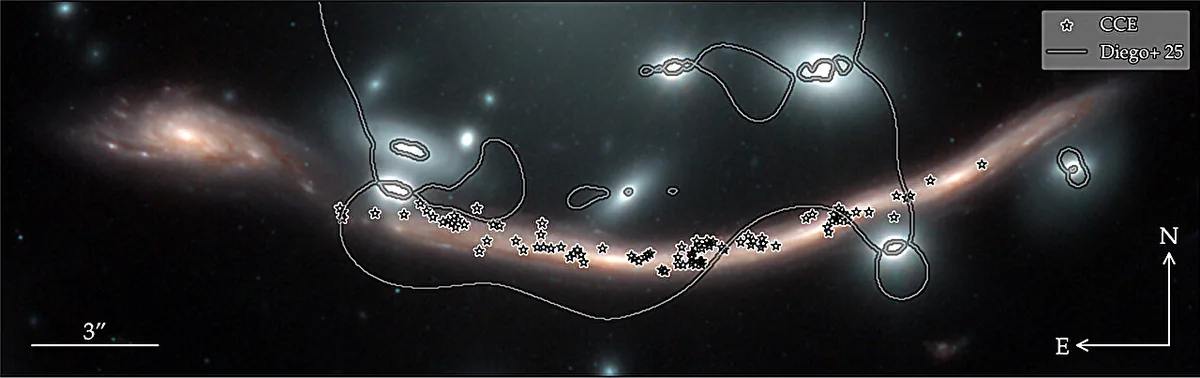
Using the James Webb Space Telescope (JWST), an international team of astronomers has achieved a major breakthrough by identifying 104 magnified stellar events within the distant galaxy known as the Dragon. Located approximately 6.5 billion light-years away from Earth, this galaxy has become a primary target for studying cosmic gravitational lensing. This new discovery more than doubles the previous record of 44 such detections within the same galaxy, setting a new benchmark for deep-space stellar observations.
Gravitational Lensing and Detailed Stellar Measurements
Gravitational lensing occurs when the immense mass of a foreground object bends and magnifies the light coming from a more distant background galaxy. Leveraging JWST's ultra-sensitive infrared capabilities, researchers were able to capture and measure individual magnified events corresponding to some of the most luminous stars in the Dragon galaxy. These precise observations reveal spatial distributions and brightness fluctuations that would otherwise remain invisible across billions of light-years.
Scientific Significance and Clues to Dark Matter
Beyond shedding light on the galaxy's most massive stellar population, these magnified events serve as a powerful probe for studying dark matter. Because the degree and pattern of magnification depend directly on the mass distribution along the line of sight, the 104 detected events provide rare empirical hints about the clumpiness and nature of dark matter. Scientists plan to use these findings to refine cosmological models and guide future high-magnification searches across the distant universe.

Comments
Loading comments...