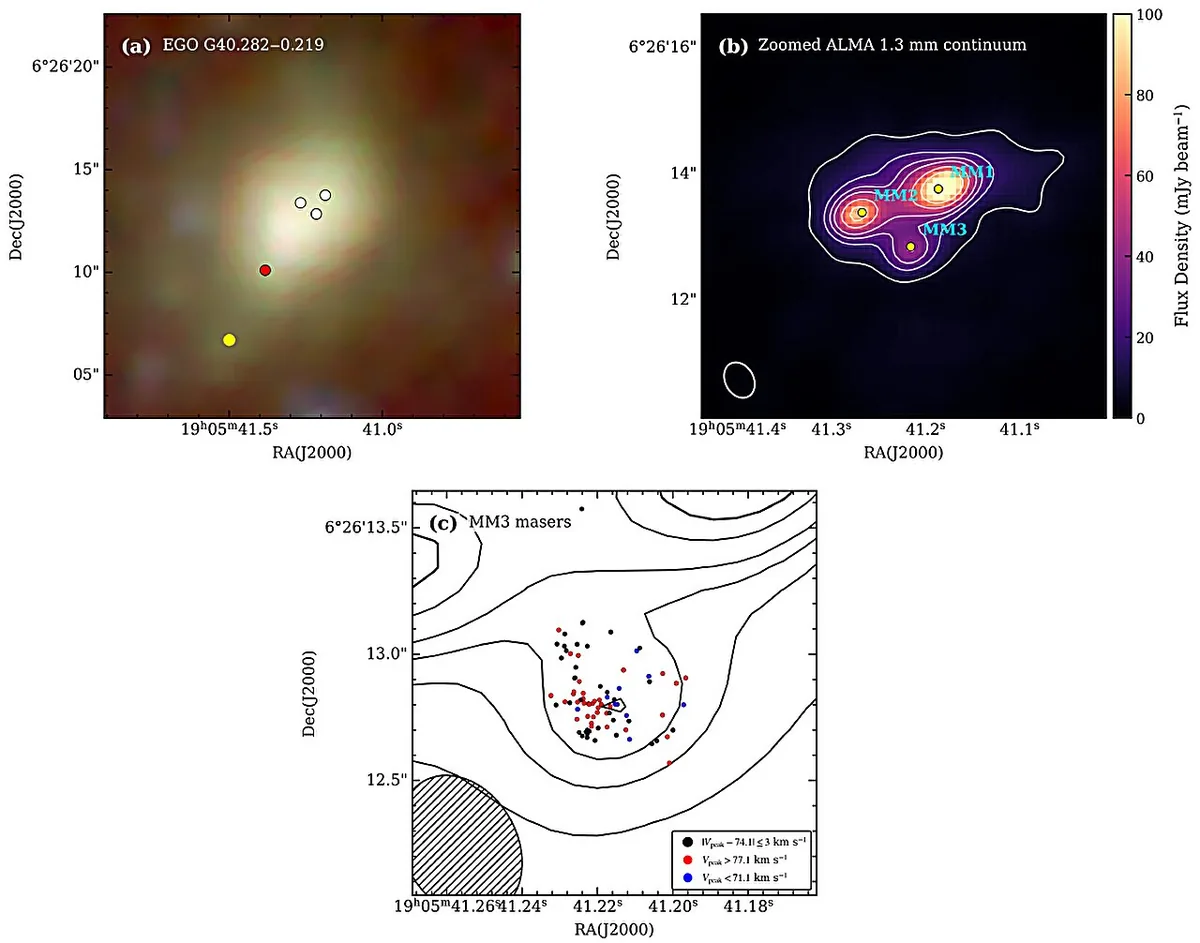
Analyzing Star Birth in Region G40.282−0.219
Astronomers studied the massive star-forming region designated G40.282−0.219 to better understand the processes behind high-mass star creation. Detailed observations revealed three distinct dense cores developing within the exact same massive gas clump.
Physical and Chemical Insights Revealed by ALMA
Data captured by the high-precision ALMA observatory demonstrated that these three cores are at completely different evolutionary stages. By analyzing observational data, researchers highlighted the significant physical and chemical variations among these cores, despite them originating from the same parent gas clump.
Implications for Star Formation Models
Co-existing within a single clump at varying developmental phases, these cores provide a unique cosmic laboratory for studying high-mass star formation. The findings help refine astrophysics models regarding how chemical composition and physical conditions evolve during the earliest stages of stellar birth.
Comments
Loading comments...