Gravitational Lensing and a Distant Supernova Discovery
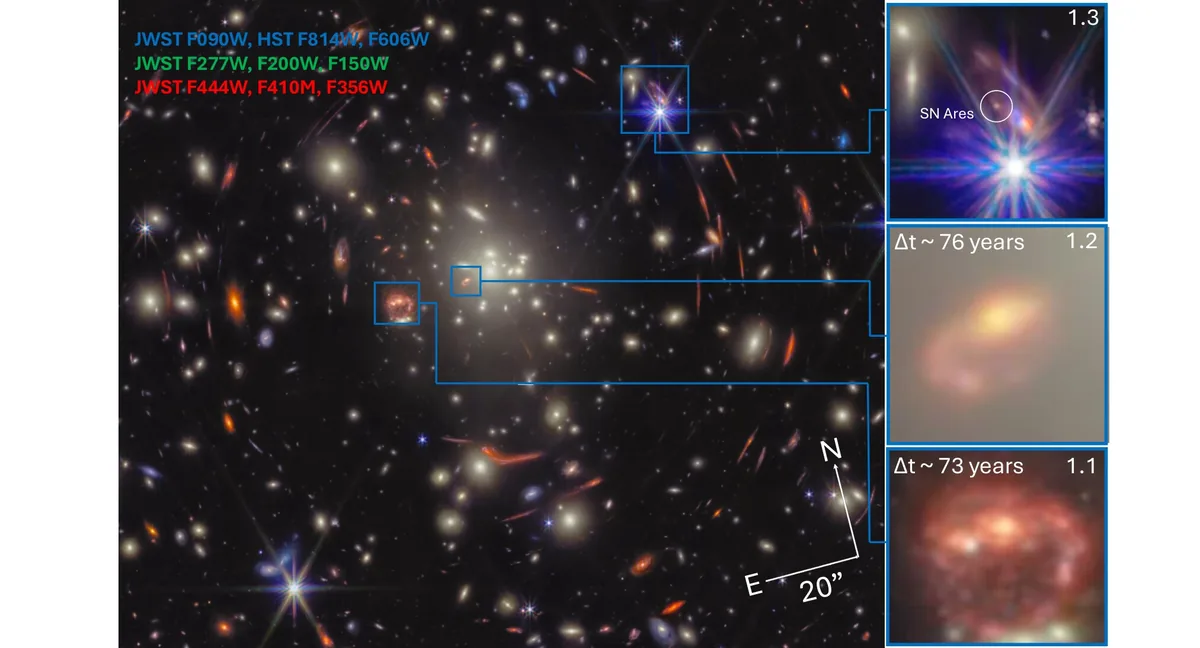
Astronomers analyzing high-resolution data from the James Webb Space Telescope (JWST) have discovered an exploding star from a time when the universe was just 4.9 billion years old. Named SN Ares, the cosmic explosion was detected thanks to the gravitational lensing effect produced by a massive galaxy cluster. The discovery paper, posted to the arXiv preprint server on October 23, details the observation and presents initial predictions regarding this rare cosmic alignment.
Optical Details and JWST Measurement Data
Gravitational lensing occurs when a foreground massive galaxy cluster bends and magnifies the light coming from more distant objects behind it, acting as a natural cosmic magnifying glass. Leveraging the advanced imaging capabilities of the James Webb Space Telescope, researchers identified how light from SN Ares was diverted along multiple paths through curved space-time. These distorted light paths created distinct images of the distant supernova explosion across different space-time delays.
Future Observations and Cosmological Significance
Calculations and theoretical models presented by the research team indicate that the remaining distorted images of SN Ares will reach observers in roughly 70 years. Having the opportunity to observe the exact same supernova explosion decades apart provides scientists with a unique probe to measure the expansion rate of the universe and refine current models of gravitational lensing. This event marks an important step forward in understanding distant cosmic phenomena and dark matter distribution in giant clusters.
Comments
Loading comments...