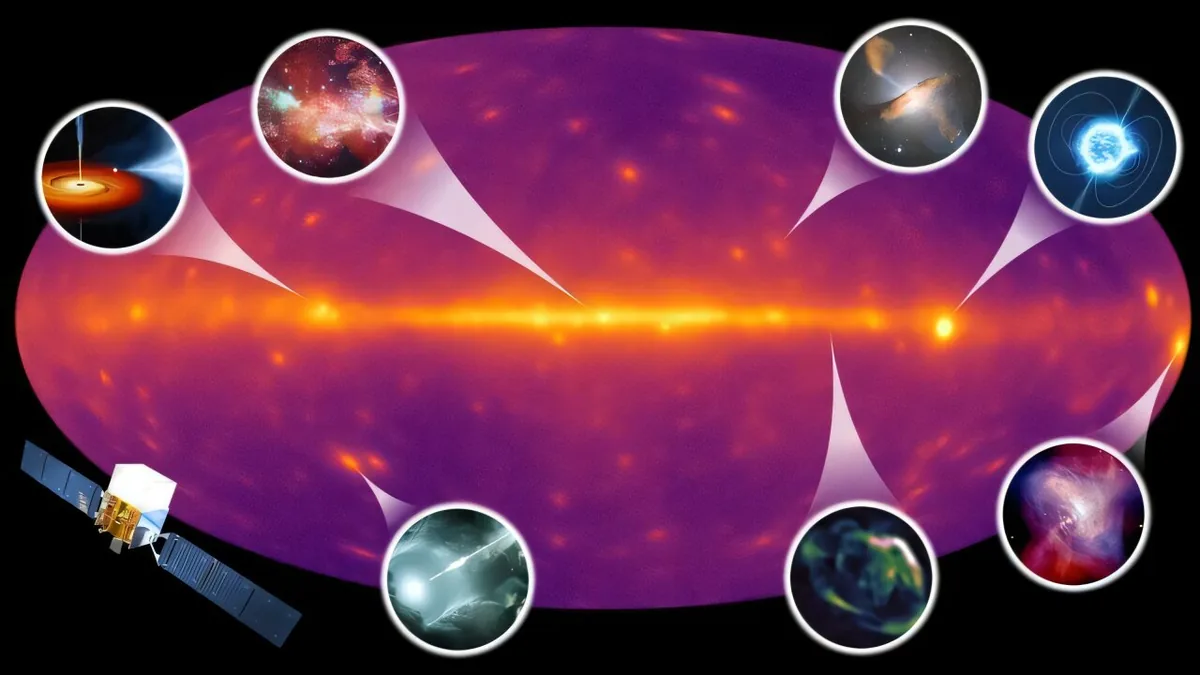
A New View of the Gamma-Ray Gap
The universe is filled with light across a wide range of energies, including extremely energetic gamma rays invisible to the human eye. These high-energy gamma rays are produced exclusively in the universe's most extreme environments, such as supermassive black holes, exploding stars, and astrophysical jets. To study these high-energy photons, astrophysicists rely on particle detectors operating in space.
The Fermi-LAT Instrument and 14 Years of Observations
Launched into space by NASA in 2008, the Fermi Large Area Telescope (Fermi-LAT) can detect photons ranging from 20 megaelectronvolts (MeV) to beyond 1 teraelectronvolt (TeV). By analyzing 14 years of observations from Fermi-LAT, astrophysicists identified around 450 gamma-ray sources in a previously unexplored energy range.
Implications for Astrophysical Models
This newly unveiled source catalog fills longstanding data gaps in high-energy astrophysics. The findings provide critical insights into particle acceleration mechanisms near black holes, supernova remnants, and cosmic jets, paving the way for future observational studies.
Comments
Loading comments...