Webb Telescopes Detects Ice in Debris Disk
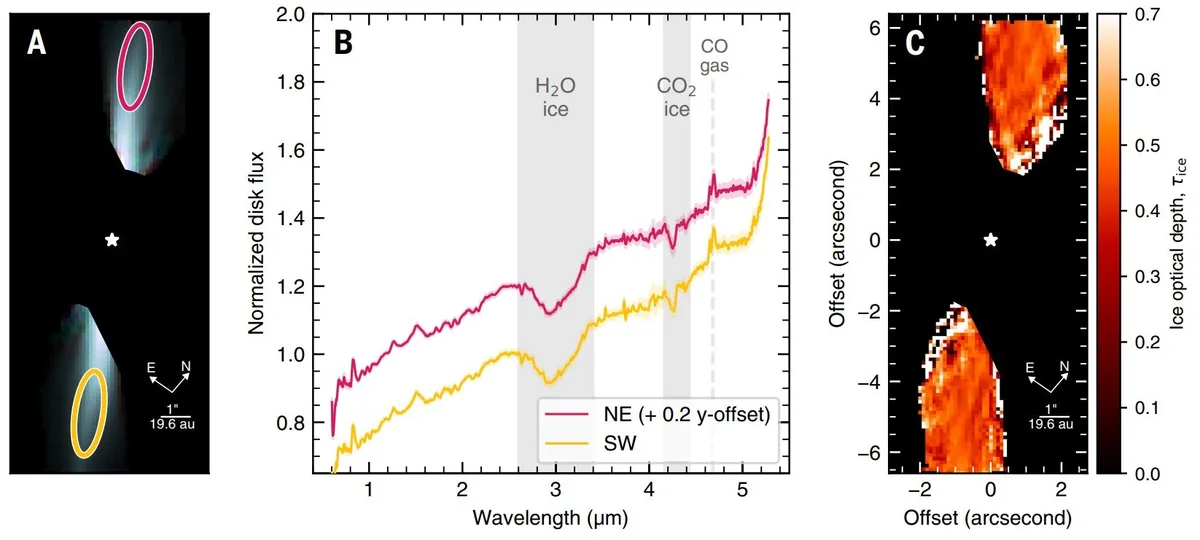
A team of astronomers analyzing infrared data collected by the James Webb Space Telescope (JWST) has detected ice around the young star Beta Pictoris for the first time. Although scientists had theoretically anticipated finding volatile ice species in the debris disk surrounding the star, previous observatories had lacked the resolution to confirm its presence. This historic direct detection sheds essential light on the early formation phases of planetary systems.
Amorphous Ice and Carbon Dioxide Signatures
The study, published in the journal Science, revealed that the discovered ice is largely noncrystalline and intimately mixed with carbon dioxide, often categorized as dirty ice. Such chemical characteristics provide spectroscopic evidence of ongoing, energetic collisions among comet-like icy bodies and planetesimals within the circumstellar disk. JWST's high-sensitivity infrared instruments succeeded in separating these faint spectral signatures from the dominant stellar glare.
Implications for Planetary System Evolution
These findings offer vital clues regarding the chaotic collision history and volatile delivery processes at work in young stellar nurseries like Beta Pictoris. By studying this active protoplanetary analogue, astrophysicists can better constrain the environmental conditions that shaped our own early Solar System. The research team intends to carry out follow-up observations to further map the distribution of volatile compounds across the circumstellar disk.
Comments
Loading comments...